
wandflower (Sparaxis tricolor)
Sources describe its habit differently, including as an upright, columnar, corm-forming herbaceous plant. Sparaxis tricolor is perennial.
Overview
Sources describe its habit differently, including as an upright, columnar, corm-forming herbaceous plant. Sparaxis tricolor is perennial.
Origin and habitat
Sparaxis tricolor is native to the Cape region of South Africa, with more specific records from the northern Bokkeveld Escarpment in the western central Cape and the northwestern Cape Province. Sources describe its habitat and cultivation conditions differently: in its native range it can grow in moist clay and stony soils, while cultivation emphasizes well-drained soil and a sunny position.
Characteristics
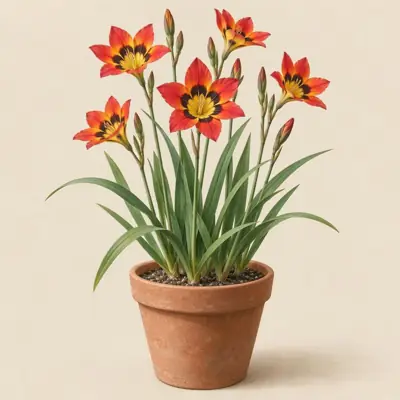
Sources differ on mature height, which is about 30–50 cm. It is reported to have a mature spread of about 0–10 cm; sources are few. The leaves are narrow and upright, ranging from sword-shaped to linear or narrowly lance-shaped. The broad, funnel-shaped flowers are often vivid red, orange, or purple and may be bicolored or tricolored, with a yellow center surrounded by a black, dark red, or brown ring; they form small, loose inflorescences on flower stems, and sources differ on the flowering period, placing it from spring into early summer.
Light
Grow in full sun; in greenhouse cultivation, provide good light while avoiding strong direct sunlight during hot periods.
Watering
Water moderately and somewhat sparingly during growth in a well-drained medium, gradually reduce watering after flowering, and keep dry during dormancy.
Humidity and airflow
It is generally reported to need good airflow.
Temperature and dormancy
It is generally reported to be frost tender; keep above freezing.
Growing medium and mounting
Use well-drained loam; for containers, a peat-free loam-based medium with sand and leaf mold can be used. Sources also indicate that it can adapt to acidic, neutral, or alkaline pH.
Propagation
Propagate by seed or by separating offsets formed beside the parent corm during dormancy.
Common problems
It generally has no notable pest or disease problems. It has low cold tolerance and is suited to a more protected position; Sparaxis plants may suffer cold damage at sufficiently low temperatures.
Identification
Its vivid bicolored or tricolored flowers are especially distinctive, typically with a yellow center surrounded by a dark ring of black, dark red, or brown.
Photos


Sources
- Wikipedia (en): Sparaxis tricolor — CC BY-SA 4.0 · link
- Wikipedia (fr): Sparaxis tricolor — CC BY-SA 4.0 · link
- Wikipedia (es): Sparaxis tricolor — CC BY-SA 4.0 · link
- GBIF descriptions: DAISIE - Inventory of alien invasive species in Europe — per dataset · link
- RHS Plants: Sparaxis tricolor — © RHS, facts only · link
- USDA PLANTS Database: Sparaxis tricolor — Public domain (US Government work) · link
- NC State Plant Toolbox: Sparaxis (genus-level) — copyright (facts only) · link