
Peace Lily (Spathiphyllum wallisii)
Spathiphyllum wallisii is an evergreen, clump-forming herbaceous perennial.
Overview
Spathiphyllum wallisii is an evergreen, clump-forming herbaceous perennial.
Origin and habitat
Sources differ on its native range, describing Colombia, Central America and nearby tropical parts of the Americas, while some also include Venezuela, Mexico and the Caribbean. It occurs in tropical America in tropical to subtropical, frost-free environments and is sensitive to cold and frost.
Characteristics
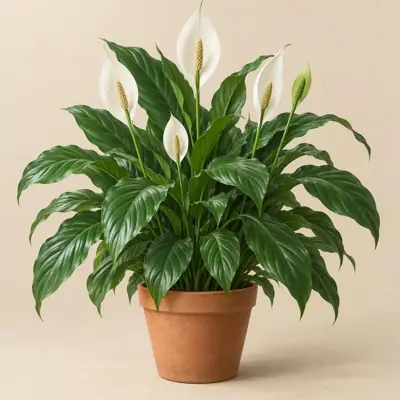
Sources differ on mature height, placing it at about 10–50 cm, while a single source reports a mature spread of about 10–50 cm. The leaves arise from the base and are glossy and dark green, with prominent veins and tapering tips; sources differ in describing their shape from ovate to lanceolate, with long petioles and an arching habit. The inflorescence has a slender, densely flowered, creamy-white to ivory spadix surrounded by a large white ovate spathe, and both spadix and spathe turn green as they age. A flowering season is reported by a single source.
Light
It grows in partial shade to shade and should be protected from strong direct light; overly dark conditions may reduce flowering. It is generally reported to tolerate low light.
Watering
Keep the growing medium moderately moist without waterlogging, watering after the surface dries slightly; watering is more frequent in summer, while winter conditions are kept drier.
Humidity and airflow
It is generally reported to prefer high humidity and to need good airflow.
Temperature and dormancy
A single source reports a lower temperature of about 4.4 °C, so sources are few. It is frost tender; keep above freezing. A single source gives differing hardiness-zone guidance.
Growing medium and mounting
Use a well-drained medium that retains moderate moisture; loamy, sandy or chalky soils may be used across acidic, neutral or alkaline conditions, while potting media should be rich in organic matter. It is generally reported to be rhizomatous.
Feeding
Feeding during active growth is used to promote flowering; RHS recommends balanced liquid fertilizer applied regularly, while NHK recommends slow-release fertilizer from spring through autumn.
Propagation
Propagate by division, separating basal shoots or clumps. Sources differ on timing: RHS recommends division in winter or after flowering, while NHK provides a different genus-level division period.
Common problems
Sources differ in reports of spider mites, scale insects and mealybugs; spider mites may be more likely in dry conditions, while poor airflow may increase scale problems. Horticultural sources generally report no particularly prominent diseases, although overly wet, poorly drained growing media may lead to root rot. Strong direct light, lack of water or low humidity may cause brown leaf tips, while overly dark conditions or excessively crowded roots may reduce flowering. Frost and low temperatures can be damaging, with prolonged cold potentially injuring leaves, stems and roots, while strong direct sunlight may scorch leaves.
Identification
Spathiphyllum wallisii has glossy dark-green leaves and inflorescences composed of a large white spathe surrounding a slender creamy-white spadix; both turn green as they age, and basal shoots can form clumps.
Photos


Sources
- GBIF Backbone: Spathiphyllum wallisii Regel — CC BY 4.0 · link
- Wikipedia (en): Spathiphyllum wallisii — CC BY-SA 4.0 · link
- RHS Plants: Spathiphyllum wallisii — © RHS, facts only · link
- USDA PLANTS Database: Spathiphyllum wallisii — Public domain (US Government work) · link
- NHK みんなの趣味の園芸 植物図鑑: Spathiphyllum (genus-level) — © NHK出版, facts only · link
- NC State Plant Toolbox: Spathiphyllum (genus-level) — copyright (facts only) · link
- Top Tropicals catalog: Spathiphyllum wallisii — © Top Tropicals LLC (facts only) · link
- UF/IFAS EDIS: Chilling Injury in Tropical Foliage Plants: I. Spathiphyllum — © University of Florida (facts only) · link
- Multiply indoor plants – Sunset Magazine (sunset.com) — facts only (§12) · link