
Japanese meadowsweet (Spiraea japonica)
Spiraea japonica is a perennial deciduous woody shrub with multiple stems and an upright to semi-upright habit.
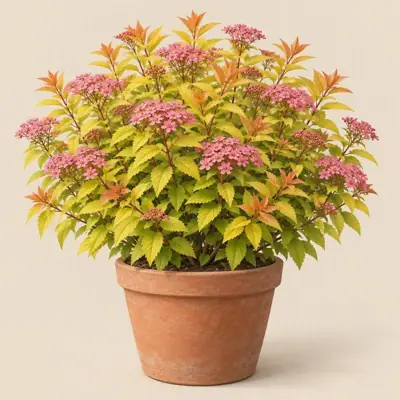
Overview
Spiraea japonica is a perennial deciduous woody shrub with multiple stems and an upright to semi-upright habit.
Origin and habitat
Sources differ on its native range, which is described as temperate East Asia, mainly including China, Japan, and the Korean Peninsula. It occurs in habitats including streams and riverbanks, wetlands, forest edges and clearings, grassy slopes, valleys, rocky or gravelly ground, roadsides, and other disturbed sites. It is native to temperate East Asia, tolerates cold, and is adapted to full sun to partial shade and conditions with some moisture but without prolonged waterlogging.
Characteristics
Sources differ on mature height, with the few sources indicating about 100–150 cm, while mature spread is 100–150 cm; growth is moderate to fast. The deciduous leaves are simple and alternate, ranging from lance-shaped to ovate or broadly ovate, with serrated margins and marked variation in shape, size, and hairiness. Many small flowers form relatively flat-topped terminal flower clusters; sources differ in their descriptions, with flower colors mainly ranging from pink to red and also including white, and a Japanese source describes the flowers as fragrant. Flowering occurs during a period described differently by the sources, while the fruit is generally reported to be a small, glossy follicle that splits open when mature to release seeds.
Light
It grows in full sun to partial shade, with ample sunlight preferred.
Watering
It needs relatively ample moisture during active growth and prefers moist, well-drained soil; ordinary to moderate watering is suitable, while prolonged saturation and waterlogging should be avoided.
Temperature and dormancy
Sources differ on the minimum temperature, with the few available sources indicating about -20 °C. It is frost hardy and is generally reported to have a USDA hardiness range.
Growing medium and mounting
It adapts to various soils, including chalk, clay, loam, and sand, and prefers fertile or good moist loam with good drainage; sources support acidic, neutral, and alkaline conditions.
Propagation
It is reported to be propagated by seed, stem cuttings, or root suckers, and its seeds can self-sow.
Common problems
Reported pests include aphids, leaf-rolling moths, and scale insects, and deer may also feed on and damage the plant. It does not tolerate prolonged waterlogged or saturated soil; in some areas it can escape cultivation, naturalize, and form dense thickets that may displace other plants. Mature plants have some cold tolerance, but sources differ substantially in their descriptions of the minimum cold temperature tolerated.
Identification
It is generally reported to have slender, much-branched twigs, alternate leaves with conspicuous serrations, and dense, relatively flat-topped pink-to-red flower clusters at the tips of current-year shoots; the species varies greatly in habit, leaf shape, hairiness, and flower color.
Photos


Sources
- GBIF Backbone: Spiraea japonica L.fil. — CC BY 4.0 · link
- Wikipedia (en): Spiraea japonica — CC BY-SA 4.0 · link
- Wikipedia (ja): シモツケ — CC BY-SA 4.0 · link
- Wikipedia (fr): Spiraea japonica — CC BY-SA 4.0 · link
- Wikipedia (es): Spiraea japonica — CC BY-SA 4.0 · link
- GBIF descriptions: Manual of the Alien Plants of Belgium; Database of Vascular Plants of Canada (VASCAN); DAISIE - Inve — per dataset · link
- NC State Plant Toolbox: Spiraea japonica — copyright (facts only) · link
- Wikipedia (nl): Japanse spirea — CC BY-SA 4.0 · link
- Useful Tropical/Temperate Plants: Spiraea japonica — CC BY-NC-SA 3.0 (facts only) · link
- RHS Plants: Spiraea japonica — © RHS, facts only · link
- USDA PLANTS Database: Spiraea japonica — Public domain (US Government work) · link
- Top Tropicals catalog: Spiraea japonica — © Top Tropicals LLC (facts only) · link