
Stephania erecta (Stephania erecta)
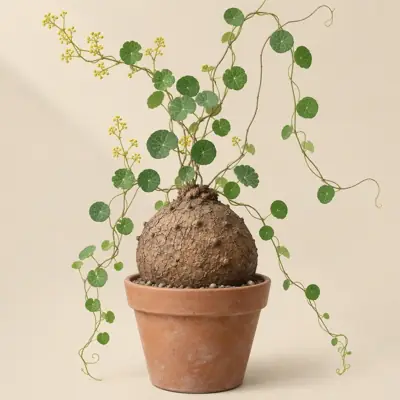
Stephania erecta is a climbing vine with a woody caudex. It is a perennial, deciduous plant with seasonal dormancy.
Overview
Stephania erecta is a climbing vine with a woody caudex. It is a perennial, deciduous plant with seasonal dormancy.
Origin and habitat
Sources differ on its native range; it is described as native to Southeast Asia, particularly Thailand and Laos. In tropical environments it grows under tree cover with filtered light, and some sources describe it as climbing on trees. Its habitat has a warm tropical climate, relatively high humidity, and a seasonal dormancy cycle.
Characteristics
Sources differ and are few on mature height, which is reported at about 60.96–152.4 cm; a limited source also reports a mature spread of about 40–40 cm. The leaves are nearly round to oval, with some descriptions calling them shield-shaped; they are green with prominent veins radiating outward from near the petiole and can become relatively large under suitable conditions. Sources differ on the flowers, which are described as small, pale yellow to yellow, and clustered; a limited source reports that flowers can appear when growth begins in spring. It has a swollen stem, and a limited source reports that Stephania can form glossy red drupes containing a curved seed.
Light
It is generally reported to prefer bright, indirect light to partial shade and to avoid strong direct sunlight.
Watering
It is generally reported to need moderate watering during growth, allowing the mix to dry somewhat between waterings, with watering greatly reduced or stopped during winter dormancy. Generally, while in leaf, water when the mix has dried, and water sparingly while leafless.
Humidity and airflow
It is generally reported to prefer high humidity.
Temperature and dormancy
Sources differ and are few on the minimum temperature, with about 10 °C reported; a limited source likewise gives about 10 °C as a cold minimum. Limited sources report an ideal temperature of about 18–25 °C and an active-temperature range of about 18–25. It is generally reported to be frost tender and should be kept above freezing. It is generally reported to drop its leaves and go dormant, with dormancy triggered by cold.
Growing medium and mounting
It is generally reported to need a well-drained medium, including mixes suitable for cacti and succulents, and a pot with good drainage. It generally needs a fast-draining mix.
Feeding
A limited source recommends applying diluted succulent fertilizer periodically during the growing period and stopping feeding during winter dormancy.
Common problems
Root or swollen-stem rot is a reported problem. Overwatering or a persistently wet medium can cause rot; yellow leaves may be associated with insufficient nutrients or water, while seasonal leaf loss can also be a normal sign of dormancy. It does not tolerate frost and should avoid freezing conditions, while warm conditions are suitable during growth.
Identification
Stephania erecta has a conspicuous round to irregular woody caudex that stores water and nutrients; during the growing season, slender climbing stems and nearly round leaves emerge from it, and the base is often described as potato-like.
Sources
- GBIF Backbone: Stephania erecta Craib — CC BY 4.0 · link
- Wikipedia (en): Stephania pierrei — CC BY-SA 4.0 · link
- The Succulent Plant Page: Stephania (genus-level) — © R.J. Hodgkiss, facts only · link
- Top Tropicals catalog: Stephania erecta — © Top Tropicals LLC (facts only) · link
- PUKUBOOK: Stephania erecta — CC BY-NC (facts only) · link
- Stephania erecta: The Ultimate Guide to Care, Cultivation, and Secrets for a Hea (www.jardineriaon.com) — facts only (§12) · link
- Stephania erecta (Stephania pierrei) – Secret Garden Plant Shop (secretgarden.ro) — facts only (§12) · link
- Stephania erecta Care Guide | Dormancy & Watering | grow urban. (growurban.uk) — facts only (§12) · link
- Stephania erecta 'L' - Araflora (www.araflora.com) — facts only (§12) · link
- DIY: how to grow your own Stephania Erecta | PLNTS.com (plnts.com) — facts only (§12) · link
- Stephania erecta | Giromagi cactus and succulents | Buy plants online (www.giromagi.com) — facts only (§12) · link