
bird-of-paradise -tree (Strelitzia nicolai)
Strelitzia nicolai is a large, evergreen, clump-forming, tree-like perennial herb with upright, somewhat woody stems and branching rhizomes.
Overview
Strelitzia nicolai is a large, evergreen, clump-forming, tree-like perennial herb with upright, somewhat woody stems and branching rhizomes.
Origin and habitat
It is native from southern to southeastern Africa, with a core distribution along the eastern coast of South Africa and in Mozambique; sources differ on whether Botswana and Zimbabwe are also included. Its habitats include coastal evergreen forest, scrub, and coastal dunes. It is reported from warm tropical to subtropical environments with little winter frost and is also suited to coastal climates with maritime influence.
Characteristics
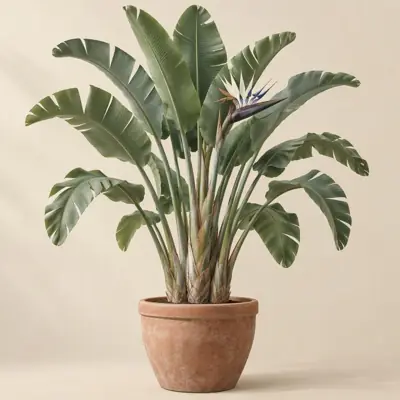
Sources differ, placing mature height at about 800–1200 cm and mature spread at about 400–800 cm. The large leaves are gray-green to glossy gray-green and banana-like, forming a fan at the tops of the stems on mature plants and tearing readily in strong winds. Large white and blue to blue-violet flowers emerge from dark, nearly black, bird-beak-shaped, spathe-like bracts; sources differ on flowering time, describing flowering mainly in spring and summer but potentially at other times under suitable conditions. It is reported to form woody, three-chambered capsules containing black seeds with orange, hairy, oily arils.
Light
It grows in full sun to partial shade; indoors, bright light or bright indirect light is suitable, and plants moved from weaker light into intense summer direct sun should be acclimated gradually to avoid leaf scorch.
Watering
During active growth, keep it moderately moist but well drained, allowing the surface soil to dry before watering again; reduce watering in winter, while established plants have better drought tolerance and prolonged extremely wet soil should be avoided.
Humidity and airflow
It is reported to prefer low humidity.
Temperature and dormancy
Sources differ, with the limited evidence placing the minimum temperature at about 10 °C. Hardiness is described as USDA and RHS classifications, and it is generally reported to tolerate brief light frost.
Growing medium and mounting
Well-drained soil is the central requirement; sources differ in describing suitable conditions, including loam, sandy or calcareous soils and a broad range of soil types and pH conditions from acidic through neutral to alkaline.
Feeding
It is reported to benefit from regular balanced liquid fertilizer during the growing period, with adequate nutrients supporting flowering.
Propagation
It can be propagated in spring by division or by separating rooted suckers, or from seed; the seeds have thick coats and require soaking before sowing.
Common problems
Prolonged excessive moisture is unsuitable, sudden movement from low light into intense summer sun can scorch the leaves, and the root system may spread vigorously. Severe frost and freezing are damaging, while strong winds can tear the large leaves; some sources indicate that mature plants can briefly withstand light frost.
Identification
Strelitzia nicolai has large banana-like leaves arranged in two ranks or forming a fan at the tops of mature stems, can develop a tall tree-like form, and bears white and blue flowers with dark bird-beak-shaped bracts.
Photos


Sources
- Wikipedia (en): Strelitzia nicolai — CC BY-SA 4.0 · link
- 維基百科:大鹤望兰 — CC BY-SA 4.0 · link
- Wikipedia (ja): オーガスタ (植物) — CC BY-SA 4.0 · link
- Wikipedia (de): Baum-Strelitzie — CC BY-SA 4.0 · link
- Wikipedia (fr): Strelitzia nicolai — CC BY-SA 4.0 · link
- Wikipedia (es): Strelitzia nicolai — CC BY-SA 4.0 · link
- GBIF descriptions: Lista de especies de plantas exóticas y trasplantadas de Colombia; Catálogo de Plantas y Líquenes de — per dataset · link
- NC State Plant Toolbox: Strelitzia nicolai — copyright (facts only) · link
- Wikipedia (it): Strelitzia nicolai — CC BY-SA 4.0 · link
- Wikipedia (nl): Strelitzia nicolai — CC BY-SA 4.0 · link
- RHS Plants: Strelitzia nicolai — © RHS, facts only · link
- Top Tropicals catalog: Strelitzia nicolai — © Top Tropicals LLC (facts only) · link