
African Violet (Streptocarpus ionanthus)
Streptocarpus ionanthus is a compact, rosette-forming evergreen herbaceous perennial that can develop a mat-like habit.
Overview
Streptocarpus ionanthus is a compact, rosette-forming evergreen herbaceous perennial that can develop a mat-like habit.
Origin and habitat
Streptocarpus ionanthus is native to Tanzania, with more specific accounts placing it in eastern and southwestern Tanzania. It is a tropical plant and is frost-sensitive.
Characteristics
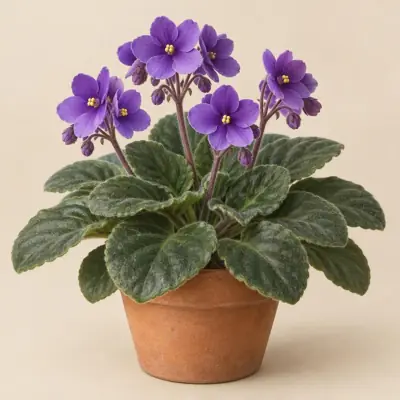
A single source reports a mature height of about 0–10 cm and a mature spread of about 10–50 cm; sources are few for these measurements. The leaves are nearly round, fleshy, hairy, and long-stalked, with green upper surfaces and often reddish-green undersides, and they form a basal rosette from the center of the plant. The tubular flowers can occur in loose clusters; the species is described as violet-blue, while cultivated forms can also have red, purple, blue, white, or pink flowers in single, semi-double, double, or ruffled forms. It is reported to be capable of flowering throughout the year.
Light
Provide bright filtered light or partial shade, avoiding hot, intense direct sunlight; indoors, it can be placed by east- or west-facing windows.
Watering
Sources describe watering somewhat differently: keep the medium moist but well drained, water thoroughly during the growing season while allowing it to become somewhat drier between waterings, and reduce watering in winter. Water can be supplied from the bottom while keeping the leaves dry, and waterlogging and overwatering should be avoided.
Temperature and dormancy
A single source reports an approximate temperature range of 15.6–26.7 °C; sources are few for this range.
Growing medium and mounting
Use a fertile, well-drained medium; RHS specifies loam that is moist but well drained and acidic to neutral. NC State suggests a fast-draining medium of sphagnum peat, vermiculite, and perlite, with lime used to adjust peat acidity, or near-neutral coir substituted for peat.
Feeding
A fertile medium supports continuous repeat flowering, and a high-potassium fertilizer can be applied during the growing season.
Propagation
Propagation is reported to be by leaf cuttings in summer.
Common problems
Potential pests include mealybugs, thrips, weevils, cyclamen or tarsonemid mites, and greenhouse leafhoppers. Potential problems include crown rot, root rot, Botrytis, and powdery mildew. Overwatering is reported to be a major cultivation problem; waterlogging can cause the plant to rot, while water on the leaves can cause spots or ring-shaped water marks. It is sensitive to frost, dry air, excessively cold irrigation water, and hot, intense sunlight, and low nighttime temperatures may inhibit growth.
Identification
It is reported to have hairy leaves forming a basal rosette, flowers commonly in blue to reddish-purple tones, and inflorescences in compound dichasial cymes.
Photos

