
Stromanthe thalia (Stromanthe thalia)
Stromanthe thalia is reported to be a rhizomatous, upright, clump-forming evergreen herb. It is reported to be a perennial herb and may also be grown as an annual or an indoor foliage plant in areas where it is not cold-hardy.
Overview
Stromanthe thalia is reported to be a rhizomatous, upright, clump-forming evergreen herb. It is reported to be a perennial herb and may also be grown as an annual or an indoor foliage plant in areas where it is not cold-hardy.
Origin and habitat
Stromanthe thalia is native to Brazil, where its habitat includes rainforest. It occurs in warm, highly humid tropical conditions.
Characteristics
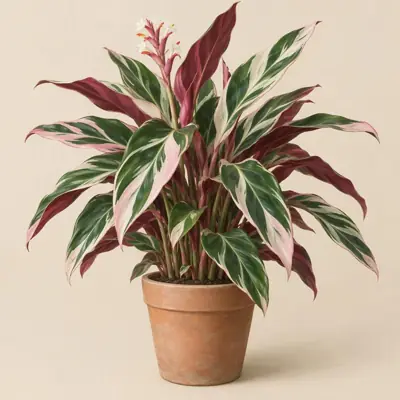
Sources differ on mature height, placing it at about 91.44–152.4 cm, while a single source reports a mature spread of about 60.96–91.44 cm. Under ideal conditions, it is reported to grow rapidly after emerging from the rhizome. The simple, glossy leaves are elliptic to oblong with entire margins; the species has dark green upper leaf surfaces and burgundy undersides, while 'Triostar' has green, white, cream, and pink variegation above and pink to burgundy undersides that may also have pink variegation, and the leaves fold upward at night. It is reported to bear panicles of small white flowers with orange-red sepals and red bracts, with flowering uncommon on indoor plants and occurring in spring.
Light
It does well in partial shade to dappled light and bright indirect light indoors; strong direct sunlight should be avoided, especially intense afternoon light that may scorch the leaves.
Watering
Keep the soil consistently moist but not waterlogged; the plant does not tolerate dry conditions, while excessive watering or poor drainage may cause rot.
Temperature and dormancy
It is generally associated with warm hardiness conditions.
Growing medium and mounting
Use moist, well-drained soil rich in organic matter.
Propagation
It can be propagated from seed or by rhizome division, with rhizome propagation described as faster and more reliable. Division is recommended in spring before new growth begins.
Common problems
Mealybugs, aphids, and spider mites are reported pests to watch for. Overwatering may lead to root and stem rot, and waterlogged conditions may also cause rot. Dry soil is unsuitable, while strong direct sunlight may scorch the leaves. This cold-sensitive tropical plant prefers warm, highly humid conditions; outdoor plants should be protected from strong winds and provided afternoon shade.
Identification
'Triostar' is reported to be especially recognizable by white, cream, and pink variegation on green leaves, pink to burgundy leaf undersides, and leaves that fold together at night.
Photos

