
American evergreen (Syngonium podophyllum)
Syngonium podophyllum is an evergreen perennial herbaceous climber that can attach by aerial roots or grow as ground cover; young plants appear more clumping, while mature plants show a more pronounced climbing habit.
Overview
Syngonium podophyllum is an evergreen perennial herbaceous climber that can attach by aerial roots or grow as ground cover; young plants appear more clumping, while mature plants show a more pronounced climbing habit.
Origin and habitat
Sources differ in their accounts of its native range, but describe it as native to tropical America, extending from Mexico and Central America into northern and western South America. It inhabits tropical forests, including dense primary forest, more open secondary forest, and foothill forest, and commonly climbs tree trunks. Its native climate is tropical, warm, and humid.
Characteristics
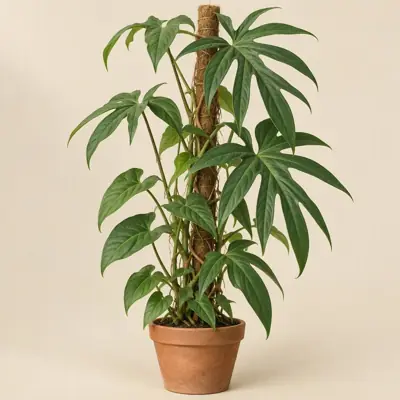
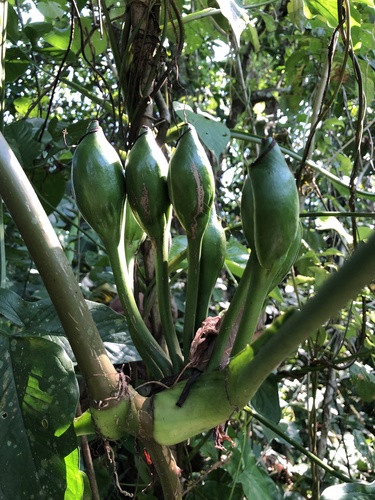
Sources differ on mature height, placing it at about 150–250 cm, while the few sources for mature spread report about 50–100 cm. Growth is rapid, and leaf form changes markedly with maturity: juvenile leaves are simple and may be ovate, heart-shaped, arrow-shaped, or hastate, while mature leaves become deeply palmately or pedately divided; wild-type plants are generally green, while cultivars may have white, silvery white, pink, yellow, or differently shaded green variegation. The inflorescence consists of a spadix with small green to greenish-white flowers surrounded by a cream, yellow-green, or white-green spathe; flowering occurs in summer but is rare indoors. As the fruit matures, the persistent spathe around the inflorescence is reported to turn red.
Light
Syngonium podophyllum prefers partial shade to bright indirect light and tolerates low light, although prolonged very low light may produce weak growth; strong direct sunlight should be avoided. Variegated cultivars generally need brighter indirect light than dark-green-leaved cultivars.
Watering
During active growth, keep the growing medium moist while maintaining good drainage and water when it becomes dry; reduce watering in winter. The foliage may be misted regularly to maintain higher air humidity.
Humidity and airflow
Syngonium podophyllum prefers high humidity.
Temperature and dormancy
Sources differ on the lower temperature guidance, with the few available sources placing it at about 15 °C, while the few sources for the upper temperature report about 38 °C. Sources differ on its USDA hardiness classification. It is generally reported to tolerate brief light frost.
Growing medium and mounting
It favors a humus-rich, fertile, moist but well-drained growing medium and can adapt from clay to sandy loam and from acidic and neutral to slightly alkaline conditions. It has aerial and soil roots and favors an airy mix.
Feeding
Sources differ on feeding: some recommend fertilizing during the growing season, with either balanced liquid fertilizer applied regularly or slow-release fertilizer applied less frequently, while another botanical-garden source indicates that the vigorous plant can generally be grown without fertilizer.
Propagation
It can be propagated by cuttings, including shoot-tip cuttings and leaf-with-bud or stem-section cuttings; division is also recorded as a propagation method. Cuttings taken in a suitable season can root within a relatively short period.
Common problems
Possible pests include aphids, two-spotted spider mites, scale insects, mealybugs, and thrips. Leaf spots, bacterial leaf spot, and soft rot may occur, although another source characterizes the plant as generally having few disease problems. Strong direct sunlight can scorch or bleach leaves, prolonged low light can cause weak growth, and dry conditions can make scale insects or spider mites more likely. It tolerates heat but has weak cold tolerance and favors warm conditions; mature plants have been reported to withstand brief temperatures near freezing, while young plants should be protected from low temperatures.
Identification
A key identifying feature is the pronounced change in leaf form with maturity: juvenile plants mainly bear arrow-shaped or hastate leaves, while mature climbing plants develop pedately or palmately divided leaves with multiple lobes; developed aerial roots allow the stems to attach to supports.
Photos


Sources
- Wikipedia (en): Syngonium podophyllum — CC BY-SA 4.0 · link
- 維基百科:合果芋 — CC BY-SA 4.0 · link
- Wikipedia (fr): Syngonium podophyllum — CC BY-SA 4.0 · link
- Wikipedia (es): Syngonium podophyllum — CC BY-SA 4.0 · link
- GBIF descriptions: Lista de especies de plantas exóticas y trasplantadas de Colombia; Lista de chequeo de las plantas n — per dataset · link
- NC State Plant Toolbox: Syngonium podophyllum — copyright (facts only) · link
- TaiCOL 臺灣物種名錄: Syngonium podophyllum — CC BY 4.0 · link
- Useful Tropical/Temperate Plants: Syngonium podophyllum — CC BY-NC-SA 3.0 (facts only) · link
- RHS Plants: Syngonium podophyllum — © RHS, facts only · link
- USDA PLANTS Database: Syngonium podophyllum — Public domain (US Government work) · link
- 臺北典藏植物園 植物資料庫: Syngonium podophyllum — © 臺北典藏植物園, facts only · link
- NHK みんなの趣味の園芸 植物図鑑: Syngonium podophyllum — © NHK出版, facts only · link
- Top Tropicals catalog: Syngonium podophyllum — © Top Tropicals LLC (facts only) · link
- Syngonium - Goosefoot: growing and care (www.promessedefleurs.ie) — facts only (§12) · link