
Aztec marigold (Tagetes erecta)
Tagetes erecta is an upright, branching, aromatic herb that commonly forms clumps. Sources differ in describing its life cycle; it is described as an annual herb.
Overview
Tagetes erecta is an upright, branching, aromatic herb that commonly forms clumps. Sources differ in describing its life cycle; it is described as an annual herb.
Origin and habitat
Sources differ on its native range, describing it as extending from Mexico to Central America, with some specifically identifying Mexico and Guatemala. In its native range it occurs in open ground, scrub, cultivated or waste ground, and pine-oak forest zones; it is also widely cultivated and can escape cultivation and become naturalized. It is suited to warm, sunny conditions and can be grown as an annual in temperate regions as well as in subtropical and tropical regions; it has low frost tolerance.
Characteristics
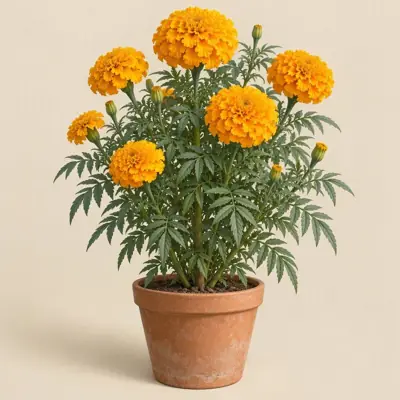
Sources differ on mature height, placing it at about 30–120 cm, while mature spread is 10–60 cm. The leaves are pinnately divided or pinnately compound, with lanceolate to linear-lanceolate leaflets; lower leaves are usually opposite and upper leaves may be alternate, with glandular dots and a distinctive aromatic smell when crushed. The flower heads are commonly yellow to orange, with white also occurring in cultivated varieties; flowers may be single or double, and large-flowered varieties have notably large blooms. Flowering mainly extends from late spring through summer into autumn and can continue for a long period under suitable growing conditions; the fruit is generally reported to be a linear achene.
Light
Full sun is preferred; insufficient light can cause elongated, weak growth and poor flowering, while light afternoon shade can be tolerated in hot regions.
Watering
Keep the soil evenly moist but well drained; established plants can tolerate drier soil, while prolonged waterlogging should be avoided.
Growing medium and mounting
Moderately fertile, well-drained soil is preferred, and the plant can adapt to sandy, loamy, and clay soils; sunny sandy loam is also suitable.
Feeding
During growth, supplemental flower fertilizer is reported to be suitable at regular intervals.
Propagation
Propagation is mainly by seed, though cuttings can also be used; seeds germinate under suitably warm conditions.
Common problems
Sources overall do not identify major common pests, with RHS describing the plant as generally having no notable pest problems. Potential diseases include powdery mildew, root and crown rots and blight caused by Phytophthora, as well as bacterial wilt. Insufficient light can cause elongated, weak growth and poor flowering; large flowers and tall varieties can make flower stems lodge and require support. Frost tolerance is low, and tall varieties may lodge in strong wind or heavy rain; some sources also report poorer growth in hot, excessively humid conditions.
Identification
Tagetes erecta has upright, readily branching stems, distinctly scented pinnate leaves, and large, conspicuous flowers that are commonly yellow or orange, with many cultivated double-flowered varieties.
Photos


Sources
- Wikipedia (en): Tagetes erecta — CC BY-SA 4.0 · link
- 維基百科:万寿菊 — CC BY-SA 4.0 · link
- Wikipedia (ja): センジュギク — CC BY-SA 4.0 · link
- Wikipedia (de): Aufrechte Studentenblume — CC BY-SA 4.0 · link
- Wikipedia (fr): Rose d'Inde — CC BY-SA 4.0 · link
- Wikipedia (es): Tagetes erecta — CC BY-SA 4.0 · link
- GBIF descriptions: Manual of the Alien Plants of Belgium; Database of Vascular Plants of Canada (VASCAN); Checklist of — per dataset · link
- NC State Plant Toolbox: Tagetes erecta — copyright (facts only) · link
- TaiCOL 臺灣物種名錄: Tagetes erecta — CC BY 4.0 · link
- 農業知識入口網 植物圖鑑: Tagetes erecta — © MOA, facts only · link
- Useful Tropical/Temperate Plants: Tagetes erecta — CC BY-NC-SA 3.0 (facts only) · link
- RHS Plants: Tagetes erecta — © RHS, facts only · link
- USDA PLANTS Database: Tagetes erecta — Public domain (US Government work) · link