
French marigold (Tagetes patula)
Tagetes patula is an annual herb with a compact, clumping, spreading habit.
Overview
Tagetes patula is an annual herb with a compact, clumping, spreading habit.
Origin and habitat
Sources differ on its native range: Mexico is central to the accounts, with some sources specifying Mexico and Guatemala and others extending the range to Nicaragua or from tropical America to Bolivia. It can grow in well-drained soils from sandy to clayey, and records also place it in farmland, vegetable gardens, gardens, parks, forest edges, and other human-influenced environments. It prefers sunny environments without severe frost, has low cold tolerance, and is commonly grown as a warm-season annual flowering plant.
Characteristics
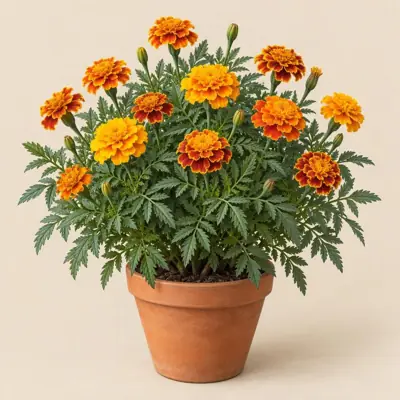
Sources differ on mature height, placing it at about 10–50 cm, while mature spread is 10–50 cm. The aromatic leaves are deeply divided or deeply pinnately divided; they are described as lance-shaped, with oil glands and a distinctive odor. The flower heads are mainly yellow or orange, with red and brown tones also occurring; cultivated forms may have single, semi-double, or double flowers, which are mostly bisexual. Flowering is mainly from spring through autumn, while some climatic conditions have a more restricted flowering period and another account describes flowering from summer to early autumn; the plant is reported to form achenes that mature and fall soon after flowering begins.
Light
Full sun is considered best; sources differ on partial sun, with some accepting it, while dark conditions are unsuitable.
Watering
Keep the soil evenly moist but well drained, watering after it has dried somewhat and avoiding prolonged wetness that can cause root rot; established plants have some drought tolerance.
Temperature and dormancy
Sources differ on the minimum temperature, with the limited accounts placing it at about 1 °C.
Growing medium and mounting
Well-drained sandy, loamy, or clay soils are suitable, and acidic, neutral, or alkaline soils are accepted; for garden cultivation, moderately fertile, well-drained soil is preferred.
Feeding
Agricultural guidance generally recommends supplemental feeding during the growing period.
Propagation
It is reported to be propagated by seed or cuttings, with seed germination under suitable warmth and cuttings rooting after a period of time.
Common problems
Spider mites and thrips are reported as possible pests. Powdery mildew, gray mold, leaf spot, and rots are reported as possible diseases. Prolonged wet soil is reported to encourage root rot, and growth may deteriorate in low temperatures. It has weak cold tolerance and is sensitive to frost; freezing temperatures may be fatal.
Identification
Tagetes patula is relatively compact, low, and spreading, with deeply divided leaves that have a noticeable aromatic or distinctive odor and flowers commonly ranging from bright yellow and orange to red and brown; compared with Tagetes erecta, it is generally shorter and more spreading.
Photos


Sources
- GBIF Backbone: Tagetes patula L. — CC BY 4.0 · link
- Wikipedia (en): Tagetes patula — CC BY-SA 4.0 · link
- 維基百科:孔雀草 — CC BY-SA 4.0 · link
- Wikipedia (fr): Œillet d'Inde — CC BY-SA 4.0 · link
- Wikipedia (es): Tagetes patula — CC BY-SA 4.0 · link
- GBIF descriptions: Manual of the Alien Plants of Belgium; The checklist of alien seed plants of D.R. Congo, based on ev — per dataset · link
- NC State Plant Toolbox: Tagetes patula — copyright (facts only) · link
- TaiCOL 臺灣物種名錄: Tagetes patula — CC BY 4.0 · link
- 農業知識入口網 植物圖鑑: Tagetes patula — © MOA, facts only · link
- RHS Plants: Tagetes patula — © RHS, facts only · link
- USDA PLANTS Database: Tagetes patula — Public domain (US Government work) · link