
Java moss (Taxiphyllum barbieri)
Taxiphyllum barbieri is reported to be a perennial moss that can grow in water or in highly humid terrestrial environments, forming loose to dense mats and attaching to surfaces such as rock and wood.
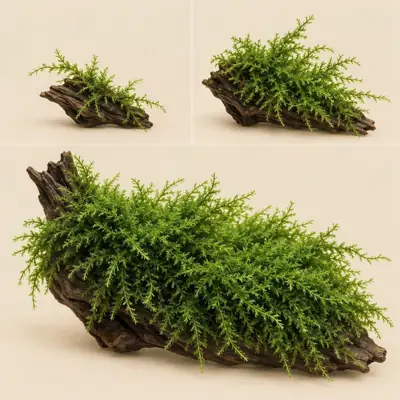
Overview
Taxiphyllum barbieri is reported to be a perennial moss that can grow in water or in highly humid terrestrial environments, forming loose to dense mats and attaching to surfaces such as rock and wood.
Origin and habitat
Sources differ on its native range in Southeast Asia: reliable text confirms wild records only from Vietnam, while other sources also list China, Thailand, and Indonesia. It is reported from humid riverbanks and watersides, growing in water or in persistently moist sites above the water and attaching to substrates such as rock. It is reported to favor humid Southeast Asian environments, particularly aquatic or persistently humid habitats near water.
Characteristics
Its leaves are reported to be arranged in rows and to lie flat, while the shoots branch loosely and irregularly and may range from bright green to dark green. It is reported not to form fruit but to produce spores in spore capsules; these capsules are uncommon in cultivation and may be brown when formed in terrestrial growth.
Light
It is reported to tolerate a broad range of light, including relatively low light, and does not require strong light.
Watering
It is reported to require aquatic or persistently moist conditions and to tolerate varied water quality, with some sources indicating that even slightly brackish water can be acceptable. When grown out of water, it is reported to favor high humidity or continual wetting by water droplets, while dry conditions hinder growth.
Temperature and dormancy
Sources differ on the ideal temperature, placing it at about 21–24 °C. A single source reports a maximum temperature of about 32 °C.
Growing medium and mounting
It is reported not to require soil or a fixed substrate and can attach to soil, rough or smooth stone, wood, or plastic, or grow unattached while floating in water.
Propagation
It is reported to be propagated vegetatively by division or by taking small pieces, which can develop into new colonies; propagation by spores is less common under cultivated conditions.
Common problems
Its mats are reported to accumulate organic debris and require periodic cleaning and thinning, and they may also be affected by algal overgrowth. Unsuitable light, temperature, or water quality, as well as excessively fine trimming, may cause decline. It is reported to be intolerant of dryness, requiring high humidity or persistent moisture when grown out of water.
Identification
It is reported to have loosely and irregularly branching shoots that can attach to substrates such as rocks, roots, and driftwood. In aquarium cultivation, it may form moss carpets or dense, net-like masses.