
Baldcypress (Taxodium distichum)
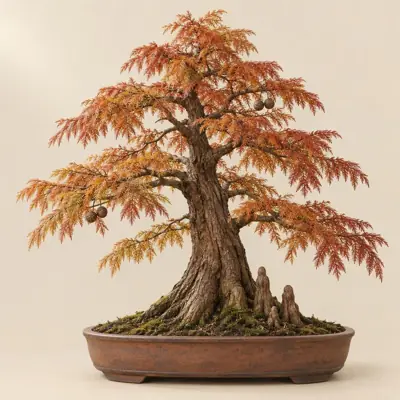
Taxodium distichum is a large deciduous coniferous tree; young trees generally have conical crowns, while older trees may develop irregular or flatter, spreading crowns. Sources differ in their descriptions, but it is a perennial, long-lived deciduous woody plant.
Overview
Taxodium distichum is a large deciduous coniferous tree; young trees generally have conical crowns, while older trees may develop irregular or flatter, spreading crowns. Sources differ in their descriptions, but it is a perennial, long-lived deciduous woody plant.
Origin and habitat
Sources differ on the native range, with its core distribution described as the southeastern United States, including the Atlantic and Gulf coasts and the lower Mississippi River basin, extending northward inland along river valleys. Typical habitats include riverbanks, swamps, floodplains, and periodically flooded wetlands; it can also be cultivated in better-drained upland soils and is highly adapted to low oxygen around the roots and flooding. It is native to warmer, humid parts of the southeastern United States, while mature trees have considerable cold tolerance and are also widely cultivated in other temperate and subtropical regions.
Characteristics
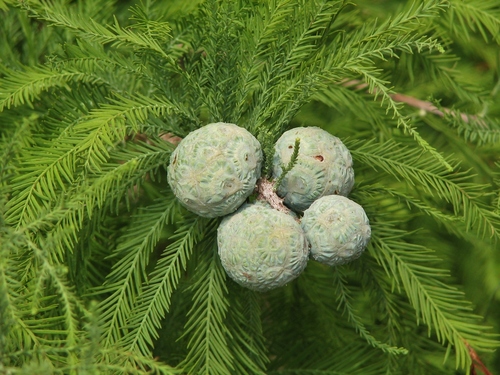
Sources differ on mature size, reporting an approximate height of 1000–5000 cm and, from few sources, an approximate spread of 600–900 cm. Sources differ on growth rate, describing it from slower to fast, with some horticultural and USDA information describing fast growth. The soft, linear to needle-like leaves are alternate and often give short shoots a two-ranked, feathery appearance; in temperate regions they change from green to yellow-brown, copper-red, or reddish-brown in autumn before falling together with some short shoots. It is reported to have separate male and female cones on the same plant, with male cones commonly clustered in hanging or tassel-like structures and female cones near shoot tips; sources differ on the timing of reproductive activity and describe the cones as nearly spherical to ovoid, green and resinous when young, and brown and woody when mature, containing seeds.
Light
Taxodium distichum can be grown in full sun and also adapts to partial shade; RHS additionally lists positions ranging from full shade to partial shade as acceptable.
Watering
It prefers a consistently moist to flooded root environment and tolerates flooding well; container-growing sources recommend keeping the soil moist, although in general cultivation it can also adapt to drier upland soils.
Humidity and airflow
It is generally reported to prefer high humidity.
Temperature and dormancy
Sources differ on its USDA hardiness-zone range. Taxodium distichum is frost hardy.
Growing medium and mounting
It adapts to a variety of soils, including clay, loam, sand, and chalk; RHS recommends acidic to neutral soils that are moist and either well drained or poorly drained, while other sources also report growth in wetlands and drier upland soils.
Propagation
Taxodium distichum can be propagated from seed; germination requires a moist medium, and USDA information also indicates that cold stratification is required.
Common problems
Serious pest problems are generally uncommon, although NC State lists bagworms and two-spotted spider mites among possible problems. RHS generally reports few pest and disease problems but indicates that honey fungus may infect plants in gardens where it is already present, while available information is insufficient to determine susceptibility. Natural regeneration by seedlings may be limited by ice damage in more northerly areas, while container-grown plants without sufficient moisture may be outside their preferred moist-root conditions. Mature plants tolerate considerable cold and are highly flood tolerant, but sources differ on the lower-temperature cultivation limit, and seedlings are more susceptible to ice damage than mature trees.
Identification
Prominent identifying features include deciduous foliage and shoots with a feathery appearance, autumn color change, woody knees that commonly project above the ground or water around the base of plants in wetlands, and a frequently conspicuously swollen trunk base.
Photos



Sources
- Wikipedia (en): Taxodium distichum — CC BY-SA 4.0 · link
- 維基百科:落羽杉 — CC BY-SA 4.0 · link
- Wikipedia (ja): ラクウショウ — CC BY-SA 4.0 · link
- Wikipedia (de): Echte Sumpfzypresse — CC BY-SA 4.0 · link
- Wikipedia (fr): Taxodium distichum — CC BY-SA 4.0 · link
- Wikipedia (es): Taxodium distichum — CC BY-SA 4.0 · link
- NC State Plant Toolbox: Taxodium distichum — copyright (facts only) · link
- Wikipedia (it): Taxodium distichum — CC BY-SA 4.0 · link
- Wikipedia (pt): Taxodium distichum — CC BY-SA 4.0 · link
- Wikipedia (ko): 낙우송 — CC BY-SA 4.0 · link
- Useful Tropical/Temperate Plants: Taxodium distichum — CC BY-NC-SA 3.0 (facts only) · link
- RHS Plants: Taxodium distichum — © RHS, facts only · link
- USDA PLANTS Database: Taxodium distichum — Public domain (US Government work) · link
- Top Tropicals catalog: Taxodium distichum — © Top Tropicals LLC (facts only) · link