
lemon thyme (Thymus citriodorus)
Thymus citriodorus is an evergreen, low-growing to mat-forming subshrub. It is generally reported to be perennial.
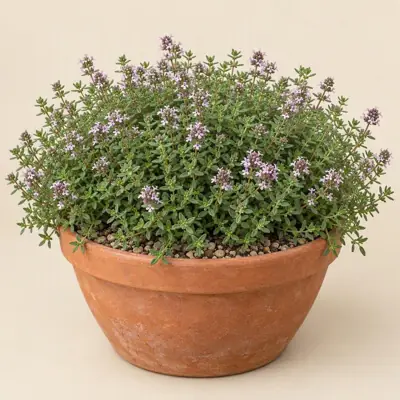
Overview
Thymus citriodorus is an evergreen, low-growing to mat-forming subshrub. It is generally reported to be perennial.
Origin and habitat
Sources differ on its native range: Europe is given broadly, while some accounts point more specifically to Spain and France or to southern Europe and the Mediterranean region. It tolerates drought and heat and, once established, is suited to drier conditions; some sources also indicate that it can overwinter in central Europe.
Characteristics
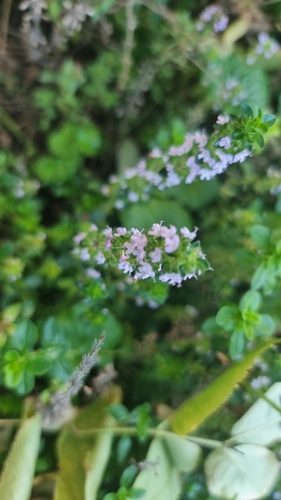
Sources differ on mature height, placing it at about 10–30 cm, while mature spread is 30 cm. The leaves have a pronounced lemon fragrance and range in shape from lanceolate and elliptic to obrhombic-ovate; cultivated varieties may have golden-yellow, silvery-white, or other variegated foliage. The small tubular flowers are mainly pink, pale purple, or purplish red and can attract pollinating insects such as bees and butterflies. Sources differ on the flowering period, with summer described as the main flowering season.
Light
Full sun is best, though partial sun is also acceptable.
Watering
Water moderately, allowing the surface to dry slightly before watering again; established plants tolerate drought, while prolonged wetness in the growing medium should be avoided.
Temperature and dormancy
A single source reports a minimum temperature of about -1.1 °C, so sources are few for this figure. Sources differ on its hardiness-zone classification. It is generally reported to tolerate brief light frost.
Growing medium and mounting
It prefers well-drained soil and is especially suited to sandy or rocky growing media.
Common problems
One source reports no significant pest problems. Overly wet soil or growing medium is reported to be a main cultivation risk and may cause root rot. Established plants tolerate drought and heat; accounts differ on cold tolerance, with one source describing only brief tolerance of light frost and a need to protect young plants from cold, while other sources and hardiness-zone information suggest greater cold tolerance.
Identification
Thymus citriodorus is low-growing and evergreen, has a strong lemon or citrus fragrance, and commonly forms dense ground-covering clumps.
Photos


Sources
- Wikipedia (en): Thymus citriodorus — CC BY-SA 4.0 · link
- Wikipedia (de): Zitronen-Thymian — CC BY-SA 4.0 · link
- Wikipedia (fr): Thym citron — CC BY-SA 4.0 · link
- GBIF descriptions: Manual of the Alien Plants of Belgium; DAISIE - Inventory of alien invasive species in Europe — per dataset · link
- NC State Plant Toolbox: Thymus citriodorus — copyright (facts only) · link
- Top Tropicals catalog: Thymus citriodorus — © Top Tropicals LLC (facts only) · link