
Mexican shellflower (Tigridia pavonia)
Tigridia pavonia is a perennial herb. Sources differ in describing its habit; it is an upright-growing bulbous herb with an underground corm.
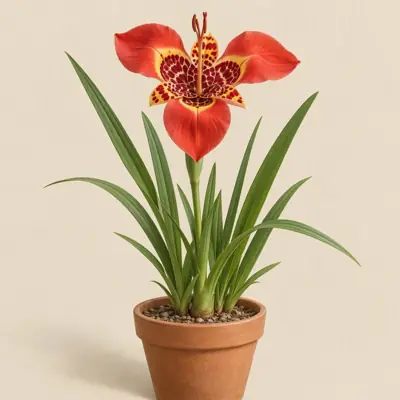
Overview
Tigridia pavonia is a perennial herb. Sources differ in describing its habit; it is an upright-growing bulbous herb with an underground corm.
Origin and habitat
Its main native range is described as extending from Mexico through Central America to at least Honduras, with Guatemala and El Salvador also included by multiple sources; sources differ on whether Colombia is part of the native range. It occurs in oak and pine forests, along roadsides, and in semi-wild settings; other sources describe the genus as commonly occurring in seasonally dry grassland or rocky environments. It is reported to be mainly adapted to subtropical environments in Central America, favoring hot summers and cool winters, and is also cultivated as an ornamental in tropical to warm-temperate regions.
Characteristics
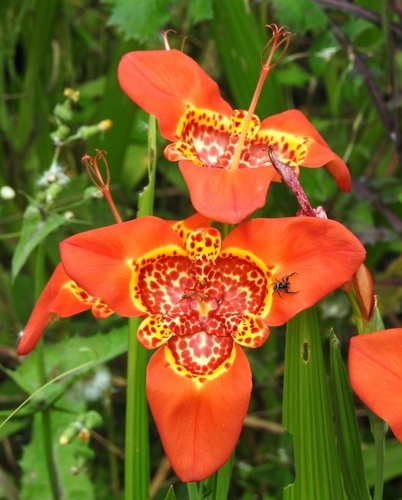
Sources differ, but mature height is reported at about 100–150 cm. From few sources, mature spread is reported at about 0–10 cm. The leaves are narrow and elongated, ranging from lance-shaped to sword-shaped. The large flowers occur in orange, pink, red, yellow, white, and other colors, with larger outer tepals, smaller inner tepals, and strongly contrasting central markings; they bloom successively in summer, with individual flowers usually opening in the early morning and closing or wilting before evening.
Light
Full sun is preferred and is consistently recommended by multiple horticultural sources, although some sources also support partial sun.
Watering
It needs ample water during the growing season in a well-drained medium, while the medium should be kept dry during dormancy.
Temperature and dormancy
Sources differ, but a minimum temperature of about -8 °C is reported. It is generally listed as RHS H1C and as tolerating brief light frost.
Growing medium and mounting
It grows in well-drained, light sandy soil to loam, with fertile, sandy media preferred; the soil may be acidic, neutral, or alkaline.
Propagation
It can be propagated by sowing seed in spring or by separating lateral corms during dormancy or in autumn.
Common problems
Sources differ on pests: the aphid Aphis newtoni has been recorded on Tigridia pavonia, while RHS generally reports no notable horticultural pest problems. Good drainage is important; plants left outdoors through winter in cold regions may be affected by low temperatures, while in regions with cool summers they may fail to develop corms sufficiently for the following season. Cold tolerance is limited and sources differ on the minimum tolerated temperature; in regions with cold winters, lifting corms for frost-free overwintering is recommended, and planting sites should be sheltered from strong winds.
Identification
The flowers are brightly colored with conspicuous contrasting spots or markings at the center; individual flowers are short-lived, but the same plant can continue producing new flowers.
Photos



Sources
- Wikipedia (en): Tigridia pavonia — CC BY-SA 4.0 · link
- 維基百科:虎皮花 — CC BY-SA 4.0 · link
- Wikipedia (fr): Tigridia pavonia — CC BY-SA 4.0 · link
- Wikipedia (es): Tigridia pavonia — CC BY-SA 4.0 · link
- GBIF descriptions: Lista de especies de plantas exóticas y trasplantadas de Colombia; Especies forestales que ofrecen p — per dataset · link
- Wikipedia (nl): Tigridia pavonia — CC BY-SA 4.0 · link
- Wikipedia (pt): Flor-tigre — CC BY-SA 4.0 · link
- Useful Tropical/Temperate Plants: Tigridia pavonia — CC BY-NC-SA 3.0 (facts only) · link
- RHS Plants: Tigridia pavonia — © RHS, facts only · link
- NC State Plant Toolbox: Tigridia (genus-level) — copyright (facts only) · link