
Tillandsia aeranthos (Tillandsia aeranthos)
Tillandsia aeranthos is an evergreen, clump-forming epiphytic herb that can be grown as an air plant. It is an evergreen perennial.
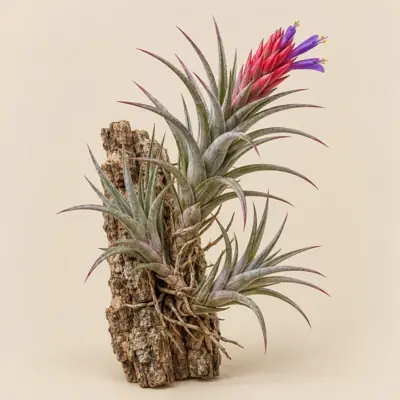
Watch: 25 Air Plants: No Soil, Seriously
Overview
Tillandsia aeranthos is an evergreen, clump-forming epiphytic herb that can be grown as an air plant. It is an evergreen perennial.
Origin and habitat
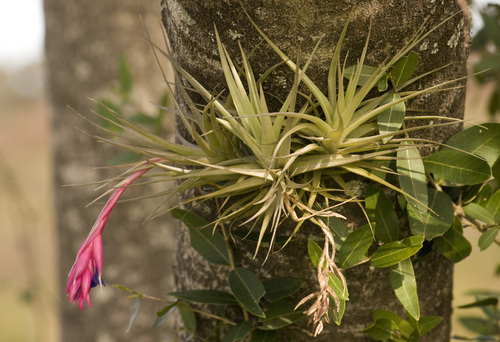
Tillandsia aeranthos is native to South America, including southern Brazil to the São Paulo area, Paraguay, Uruguay, and northern Argentina and the Río de la Plata region. Tillandsia species are reported to grow mainly as epiphytes on trees and can also attach to surfaces such as rocks without relying on soil. Its reported distribution and cultivation information generally point to warmer, rainy environments in South America, with some cold tolerance.
Characteristics
A single source reports a mature height and spread of about 10–50 cm, so sources are few. The leaves are reported to be narrowly triangular with tapering tips, purplish green, densely covered with silvery-white scales, and slightly concave. Growth is reported to be relatively fast. The inflorescence is reported to be a dense, head-like spike with sessile flowers, bright red bracts, and purple petals.
Light
Sources differ on the light description, but bright, diffused light or partial sun is recommended, with bright shade in summer. Bright indirect light is suitable.
Watering
Sources differ on watering details, but describe regular watering during the growing season, thorough draining, good airflow, and increased watering in hot, dry conditions; general Tillandsia care also emphasizes drying quickly after watering and avoiding prolonged water retention at the leaf bases. Soak, then let dry. A single source reports that the plant should dry promptly after watering.
Humidity and airflow
Tillandsia aeranthos is reported to need good airflow.
Temperature and dormancy
A single source suggests a lower temperature of about 0 °C, so sources are few. It is reported to be frost tender; keep above freezing.
Growing medium and mounting
Tillandsia aeranthos usually does not require growing medium and can be secured to supports, wood, cork, or bark. It is suited to being mounted.
Feeding
General Tillandsia cultivation guidance reports low fertilizer needs, with little or no fertilizer required.
Propagation
Tillandsia aeranthos can be propagated from seed or by separating lateral offsets once they have reached a sufficient size relative to the parent plant.
Common problems
Possible pests include aphids, mealybugs, scale insects, and mites. Sources differ on disease issues: disease is generally uncommon, while Tillandsia cultivation information also records sooty mold and crown rot as possible problems. A single source reports that retained water in the center or between leaves combined with poor airflow can cause rot, while insufficient water may cause dry brown leaf tips and excessive light may cause bleaching or browning of the tips. A sheltered position is recommended; during hot summer conditions, avoid excessively strong sunlight and increase watering according to dryness.
Identification
Tillandsia aeranthos can be grown secured to a support without growing medium; Tillandsia roots mainly provide anchorage, while scales on the leaf surfaces can absorb water and nutrients.
Photos


Sources
- Wikipedia (en): Tillandsia aeranthos — CC BY-SA 4.0 · link
- Wikipedia (ja): キノエアナナス — CC BY-SA 4.0 · link
- Wikipedia (es): Tillandsia aeranthos — CC BY-SA 4.0 · link
- RHS Plants: Tillandsia aeranthos — © RHS, facts only · link
- Rainforest Flora care guide: Tillandsia (group-level) — © Rainforest Flora, facts only · link
- NHK みんなの趣味の園芸 植物図鑑: Tillandsia (genus-level) — © NHK出版, facts only · link
- NC State Plant Toolbox: Tillandsia (genus-level) — copyright (facts only) · link