
Tillandsia bergeri (Tillandsia bergeri)
Tillandsia bergeri is an evergreen perennial. Sources differ in describing its habit; it is described as a clumping perennial herb that may grow as an epiphyte or on rocks, forming short-stemmed rosettes.
Watch: 25 Air Plants: No Soil, Seriously
Overview
Tillandsia bergeri is an evergreen perennial. Sources differ in describing its habit; it is described as a clumping perennial herb that may grow as an epiphyte or on rocks, forming short-stemmed rosettes.
Origin and habitat
Sources differ on its native range, described as extending from Rio Grande do Sul in Brazil to Buenos Aires Province in Argentina. Tillandsia species are reported to commonly grow as epiphytes on trees and can also grow on surfaces such as rocks, with roots used mainly for anchorage. The genus Tillandsia occurs in tropical to warm-temperate environments, while the natural distribution of Tillandsia bergeri extends into southern Brazil and the Buenos Aires area of Argentina.
Characteristics
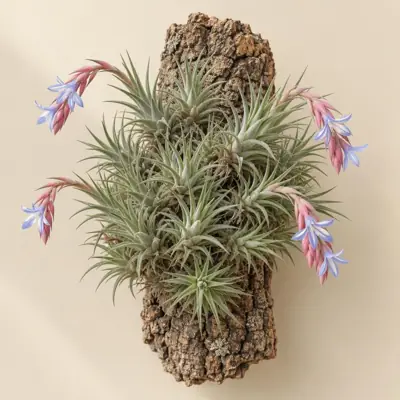
Few sources report mature height and spread; both are about 10–50 cm. Tillandsia species typically form rosettes of linear or strap-shaped, relatively leathery leaves, and many have scale-like hairs on the leaf surface that absorb water and nutrients. It is reported to have inflorescences with pink bracts and pale blue petals with a white central band; the corolla is open and the petals are twisted, with flowering in spring. It is reported to grow slowly but steadily and can eventually form large, dense clumps.
Light
Provide partial sun or bright indirect light, with bright shade in summer. It is generally described as preferring bright indirect light.
Watering
Sources differ on watering: provide moderate water during the growing season and less at other times, and after watering or soaking, remove standing water from the plant base and between the leaves while maintaining good ventilation so the plant dries as soon as possible. It is generally recommended to soak, then let dry. It is reported to require drying promptly after watering.
Temperature and dormancy
It is reported as RHS H1C. Few sources report a minimum temperature, at about -10 °C. It is generally described as frost tender; keep above freezing.
Growing medium and mounting
It is reported to grow attached to bark boards or trees; in containers, a medium for terrestrial bromeliads may be used, while outdoors it may grow in coarse, loose, open, humus-rich soil. It is generally described as a plant that can be mounted, grown in a basket or potted.
Feeding
Tillandsia species are reported to generally require little or no fertilizer, although some container-grown types may receive small amounts of slow-release fertilizer from spring through autumn.
Propagation
It can be propagated from seed or by separating offsets after they have reached at least roughly a third of the parent plant's size.
Common problems
Possible pests include aphids and mealybugs, while genus-level information also records scale insects and mites among problems affecting Tillandsia. RHS records little disease in general, while genus-level information indicates that crown rot may occur with poor ventilation or inadequate drying and also records sooty mold. Brown, crisp leaf tips are reported to possibly indicate insufficient water, while water remaining for a long time in the plant center or between leaves after watering may lead to rot. Sources differ on weather sensitivity: it is described as tolerating drought, wet conditions and brief cold, while RHS recommends a frost-free, sheltered environment and classifies it as H1C.
Identification
Tillandsia bergeri can form clumps; as a Tillandsia, it can absorb water and nutrients through specialized scales on its leaves, while its roots mainly serve for anchorage.
Photos


Sources
- Wikipedia (en): Tillandsia bergeri — CC BY-SA 4.0 · link
- Wikipedia (fr): Tillandsia bergeri — CC BY-SA 4.0 · link
- Wikipedia (es): Tillandsia bergeri — CC BY-SA 4.0 · link
- RHS Plants: Tillandsia bergeri — © RHS, facts only · link
- Rainforest Flora care guide: Tillandsia (group-level) — © Rainforest Flora, facts only · link
- NHK みんなの趣味の園芸 植物図鑑: Tillandsia (genus-level) — © NHK出版, facts only · link
- NC State Plant Toolbox: Tillandsia (genus-level) — copyright (facts only) · link