
Tillandsia butzii (Tillandsia butzii)
Tillandsia butzii is reported to be an evergreen, perennial epiphytic herb; in Tillandsia, many species grow attached to surfaces such as tree trunks and rocks, with roots used mainly for anchorage.
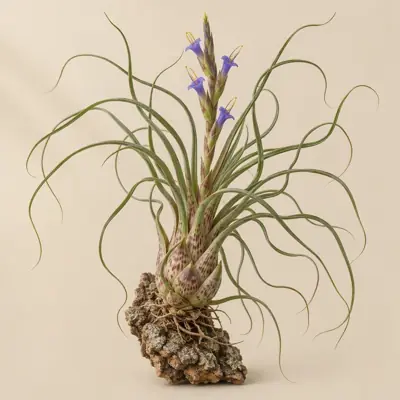
Watch: 25 Air Plants: No Soil, Seriously
Overview
Tillandsia butzii is reported to be an evergreen, perennial epiphytic herb; in Tillandsia, many species grow attached to surfaces such as tree trunks and rocks, with roots used mainly for anchorage.
Origin and habitat
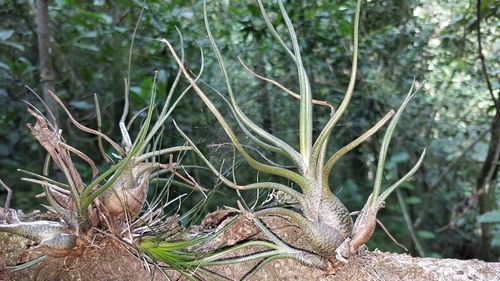
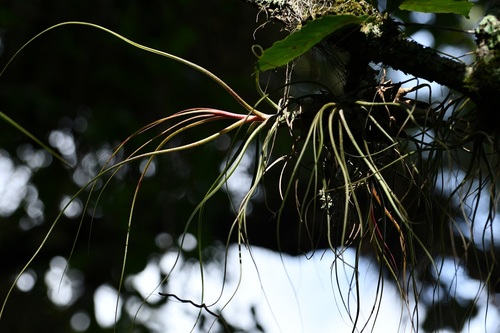
Sources differ on its native range, describing it as extending from southern Mexico and the West Indies south to Colombia and Guyana. The genus Tillandsia is reported from forests, deserts, and mountainous areas, with many species naturally growing as epiphytes on tree trunks, rocks, or cliffs. Tillandsia as a genus is reported to occur across tropical to warm-temperate environments.
Characteristics
Tillandsia leaves are reported to bear scale-like trichomes that can absorb water and nutrients; leaves in the genus are generally described as strap-shaped, fleshy, and covered with gray scales. The flowers are reported to be nearly sessile and borne in spikes, with blue to violet petals and stamens projecting beyond the petals. Sources differ, with the few available accounts placing mature height at about 20–30 cm. The fruit is reported to be an elongated capsule, described as narrowly cylindrical with a curved, beak-like tip.
Light
Sources differ in their descriptions of light needs, but generally indicate a bright setting; indoors, ample light is suggested, while bright shade and avoidance of excessive exposure are suggested in summer, and tolerance of direct sun varies among Tillandsia species. Bright indirect light is generally reported as suitable.
Watering
Sources differ, but generally recommend regular watering followed by rapid drying and good airflow, with retained water shaken from the base and between leaves to reduce the risk of rot. A reported watering method is to soak, then let dry. Prompt drying after watering is reported to be required.
Humidity and airflow
Tillandsia butzii is reported to need good airflow.
Growing medium and mounting
It is generally reported not to require ordinary potting soil and may be hung or attached to surfaces such as wood, rock, shell, bark, or cork. It is generally grown mounted.
Feeding
Sources differ on feeding: fertilizer needs are described as low, with recommendations ranging from almost no fertilizer to diluted water-soluble fertilizer during active growth.
Propagation
It is reported to be propagated from offsets formed after flowering, which may be separated after they have developed sufficiently relative to the parent plant. Propagation from seed is also reported, but growth is described as very slow.
Common problems
Reported pests include scale insects, mites, and mealybugs. Sooty mold and crown rot are reported problems, and sooty mold may be associated with scale-insect secretions. Brown, crisp leaf tips may be associated with insufficient water; prolonged retention of water at the plant base or between leaves may cause rot, while excessive light may cause browning or bleaching and insufficient light may result in weak, elongated growth. Tillandsia as a genus is generally reported to tolerate heat well, while cold tolerance is moderate to relatively weak.
Identification
Reported genus-level features include absorbing water and nutrients through leaf trichomes and using roots mainly for attachment, so many Tillandsia species do not need to grow in soil.
Photos


Sources
- Wikipedia (ja): チランジア・ブッツィー — CC BY-SA 4.0 · link
- Wikipedia (es): Tillandsia butzii — CC BY-SA 4.0 · link
- Rainforest Flora care guide: Tillandsia (group-level) — © Rainforest Flora, facts only · link
- NHK みんなの趣味の園芸 植物図鑑: Tillandsia (genus-level) — © NHK出版, facts only · link
- NC State Plant Toolbox: Tillandsia (genus-level) — copyright (facts only) · link