
giant airplant (Tillandsia fasciculata)
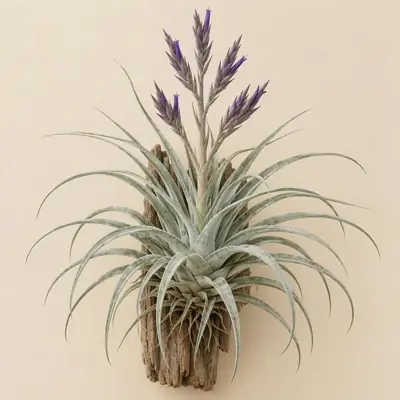
Tillandsia fasciculata is a perennial herbaceous epiphyte that can grow without soil.
Watch: 25 Air Plants: No Soil, Seriously
Overview
Tillandsia fasciculata is a perennial herbaceous epiphyte that can grow without soil.
Origin and habitat
Its native range includes Mexico, Central America, the West Indies or Antilles, northern South America, and Florida and Georgia in the southeastern United States; South American records include Colombia, Venezuela, Suriname, French Guiana, and northern Brazil. Tillandsia species are mostly epiphytes that can grow attached to tree trunks, rocks, and other surfaces, and the genus occurs in forest, desert, and mountain environments; Tillandsia fasciculata has also been recorded across a broad elevational range in Colombia. The genus Tillandsia is primarily tropical to warm-temperate, while the native range of Tillandsia fasciculata extends from the southeastern United States, Mexico, and Central America to northern South America.
Characteristics
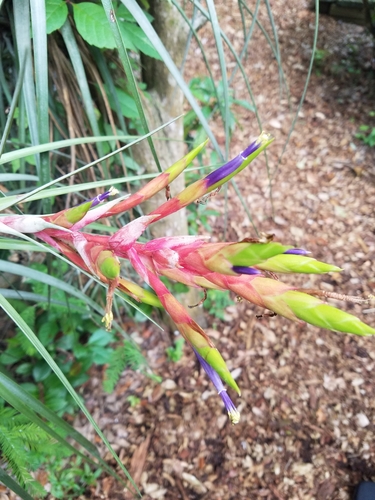
Few sources report a mature height of about 10–100 cm. Tillandsia leaves are reported to bear scales or trichomes that absorb water and nutrients, with genus-level descriptions noting often strap-like leaves with gray scales. The inflorescence is reported to be upright, ranging from unbranched through nearly finger-like branching to densely twice-pinnate, with purple to deep-purple petals. A source reports distinct flowering and fruiting periods, and describes the fruit as a capsule.
Light
Sources differ on indoor light recommendations: guidance ranges from bright indirect light to very high indoor light, including the sunniest window, while another source recommends ample sunlight during cooler parts of the year and bright shade during the warmer part. Bright indirect light is generally recommended.
Watering
Sources differ in their specific watering guidance, but indicate that the plant should absorb water thoroughly and then dry quickly, without water remaining in the leaf rosette or around the base. Generally, soak, then let dry, with the plant drying promptly after watering.
Humidity and airflow
Tillandsia fasciculata is reported to need good airflow.
Growing medium and mounting
Air plants generally do not need traditional potting soil and may be attached to or suspended from wood, cork, bark, rocks, or similar surfaces; their roots are used mainly for anchorage rather than as the primary means of absorbing water and nutrients. A mounted growing style is generally preferred.
Feeding
Tillandsia generally requires little to no fertilizer in cultivation.
Propagation
Tillandsia fasciculata can be propagated from offsets produced by the parent plant, and Tillandsia can also be grown from seed, although seed propagation is reported to be very slow. One source recommends selecting well-developed offsets for division.
Common problems
Cultivated Tillandsia may be affected by scale insects, mites, and mealybugs, while Tillandsia fasciculata in the United States is threatened by the Mexican bromeliad weevil Metamasius callizona, which may cause local disappearance. Crown or central rosette rot is reported, and one Tillandsia source also lists sooty mold. Prolonged water accumulation in the rosette, crown, or base can cause rot, so excess water should be removed after watering and good airflow maintained to promote rapid drying. Genus-level horticultural information reports strong heat tolerance but ordinary to relatively weak cold tolerance.
Identification
Typical Tillandsia can form a rosette, attach to other surfaces with relatively few slender roots used mainly for anchorage, and absorb water and nutrients through specialized scales on the leaves.
Photos


Sources
- GBIF Backbone: Tillandsia fasciculata Sw. — CC BY 4.0 · link
- Wikipedia (en): Tillandsia fasciculata — CC BY-SA 4.0 · link
- 維基百科:束状铁兰 — CC BY-SA 4.0 · link
- Wikipedia (fr): Tillandsia fasciculata — CC BY-SA 4.0 · link
- Wikipedia (es): Tillandsia fasciculata — CC BY-SA 4.0 · link
- GBIF descriptions: Catálogo de Plantas y Líquenes de Colombia — per dataset · link
- USDA PLANTS Database: Tillandsia fasciculata — Public domain (US Government work) · link
- Rainforest Flora care guide: Tillandsia (group-level) — © Rainforest Flora, facts only · link
- NHK みんなの趣味の園芸 植物図鑑: Tillandsia (genus-level) — © NHK出版, facts only · link
- NC State Plant Toolbox: Tillandsia (genus-level) — copyright (facts only) · link