
Air Plant (Tillandsia hybrid)
Tillandsia is reported to be a genus of perennial herbaceous plants, most of which are epiphytes, with some growing on rocks and a few adapted to ground environments. It is reported to be perennial; after flowering, a plant can produce offsets before the mother plant dies.
Overview
Tillandsia is reported to be a genus of perennial herbaceous plants, most of which are epiphytes, with some growing on rocks and a few adapted to ground environments. It is reported to be perennial; after flowering, a plant can produce offsets before the mother plant dies.
Origin and habitat
Tillandsia is reported to be native to tropical and subtropical parts of the Americas, with its distribution described as extending from northern Mexico and the southeastern United States through Central America and the Caribbean to central Argentina. The genus is reported from diverse habitats including tropical rainforests, high-elevation Andean regions, rocky environments, and swamps; many species grow as epiphytes on substrates such as tree branches, while others grow on rocks. Its habitats span varied conditions; green-leaved forms are generally associated with cooler, humid, shaded environments, while gray-leaved forms are more often associated with lower rainfall, high atmospheric humidity, and stronger sunlight.
Characteristics
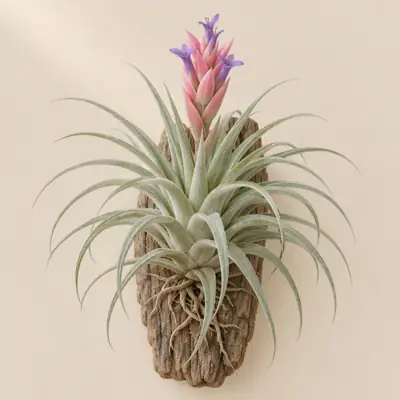
The leaves are reported to often form rosettes, with surface trichomes that absorb water and nutrients; leaf coloration within the genus can show varying degrees of silvery gray. The flowers are reported to be bisexual, with floral parts arranged in threes and a double perianth; within the genus, flowers can be red, yellow, purple, pink, or multicolored and may occur on one or several flower stalks.
Light
Tillandsia generally requires bright light; silvery-gray, stiffer-leaved types generally need more sunlight, while softer-leaved types need less, and shade is recommended during the hottest part of the day outdoors in summer. It is generally suited to bright indirect light.
Watering
Water is reported to be absorbed mainly through the leaves; in cultivation, plants may be misted or briefly soaked, should be allowed to dry completely between waterings, and are recommended to receive non-calcareous water. The reported watering method is to soak, then let dry. The plant is reported to require prompt drying after watering.
Temperature and dormancy
A minimum temperature is reported for Tillandsia, but the claim provides only qualitative precision. An ideal temperature range is reported, but the claim provides only qualitative precision. Sources differ regarding a reported maximum temperature, and the claim provides only qualitative precision.
Growing medium and mounting
Most epiphytic types are reported not to depend on soil for water and nutrients and are best attached to or placed on a substrate that does not remain saturated for long periods.
Propagation
Tillandsia is reported to be propagated from seeds formed after pollination or from offsets produced after flowering; it is also reported to be self-incompatible, so seed propagation requires pollen from another plant of the same species.
Common problems
Prolonged saturation is reported to be unsuitable for the growth habit of most epiphytic types, and plants should be allowed to dry completely after watering before being watered again. Frost tolerance is reported to vary among species; some high-elevation species can tolerate brief light frost, but this tolerance cannot be generalized to all Tillandsia.
Identification
Leaf-surface trichomes are reported to absorb water rapidly, while the roots serve mainly to anchor the plant rather than absorb water, and many species can grow without depending on soil.