
Blushing Bride (Tillandsia ionantha)
Tillandsia ionantha is an evergreen perennial herb, usually an epiphyte but also occurring as a rock-growing plant; it is generally stemless, occasionally has a short stem, and can form clumps from offsets. It is perennial.
Watch: 25 Air Plants: No Soil, Seriously
Overview
Tillandsia ionantha is an evergreen perennial herb, usually an epiphyte but also occurring as a rock-growing plant; it is generally stemless, occasionally has a short stem, and can form clumps from offsets. It is perennial.
Origin and habitat
It is native to Mexico and Central America, with some sources further describing its natural range as extending from Mexico to Costa Rica or Nicaragua. In its natural habitat, it is reported to grow as an epiphyte or on rocks without depending on soil for rooting, with the roots used mainly to anchor the plant.
Characteristics
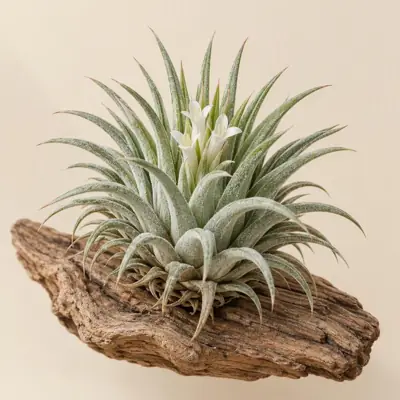
Sources differ on mature height, placing it at about 6–8 cm, while a single source reports a mature spread of about 10–50 cm. The leaves are narrowly triangular and densely covered with scale-like hairs, commonly appearing green with silvery-gray scales; on typical plants, the upper leaves can turn bright red before flowering. Sources differ in their flower descriptions: Tillandsia ionantha 'Druid' has sessile white flowers, while the typical wild form of the species usually has purple to blue-purple flowers. The plant has silvery, dense trichomes, and its fruit is reported to be a capsule.
Light
Provide bright indirect light to partial shade; bright indirect light is recommended for greenhouse cultivation.
Watering
Water regularly and thoroughly; sources recommend soaking with rainwater during the growing period, increasing watering in hot, dry conditions, and draining thoroughly afterward, with excess water between the leaves gently shaken out. Use a soak, then let dry approach, and a single source reports that the plant should dry promptly after watering.
Temperature and dormancy
The plant is generally rated RHS H1C.
Growing medium and mounting
No potting medium is required; the plant can be mounted on wood, ceramic, glass, or other supports, and tying or adhering it in place is recommended.
Feeding
During the growing season, diluted liquid fertilizer is reported to be suitable at a concentration below the usual recommendation.
Propagation
It can be propagated from seed or by separating offsets; offsets should be allowed to reach a substantial proportion of the parent plant's size before removal.
Common problems
Sources differ on pest concerns: pests are generally uncommon, but aphids and mealybugs may occur. Disease problems are generally uncommon. Excess water should not remain between the leaves for long after watering; sources recommend shaking it out or draining the plant thoroughly. A sheltered position is suitable; it can be placed outdoors in summer to benefit from rainwater, more light, and humidity, while greenhouse cultivation requires good ventilation.
Identification
Tillandsia ionantha is a small air plant with narrow leaves covered in silvery-gray scales, and it can produce many offsets to form clumps; 'Druid' is distinguished by its white flowers.
Photos


Sources
- Wikipedia (en): Tillandsia ionantha — CC BY-SA 4.0 · link
- 維基百科:Tillandsia ionantha — CC BY-SA 4.0 · link
- Wikipedia (ja): チランジア・イオナンタ — CC BY-SA 4.0 · link
- Wikipedia (fr): Tillandsia ionantha — CC BY-SA 4.0 · link
- Wikipedia (es): Tillandsia ionantha — CC BY-SA 4.0 · link
- NC State Plant Toolbox: Tillandsia ionantha — copyright (facts only) · link
- RHS Plants: Tillandsia ionantha — © RHS, facts only · link
- USDA PLANTS Database: Tillandsia ionantha — Public domain (US Government work) · link
- Rainforest Flora care guide: Tillandsia (group-level) — © Rainforest Flora, facts only · link