
potbelly airplant (Tillandsia paucifolia)
Tillandsia paucifolia is an evergreen epiphytic perennial that may grow singly or form clumps, with roots used mainly to anchor the plant. It is perennial; after flowering, the mother plant gradually declines while offsets arise from the base and continue growth.
Watch: 25 Air Plants: No Soil, Seriously
Overview
Tillandsia paucifolia is an evergreen epiphytic perennial that may grow singly or form clumps, with roots used mainly to anchor the plant. It is perennial; after flowering, the mother plant gradually declines while offsets arise from the base and continue growth.
Origin and habitat
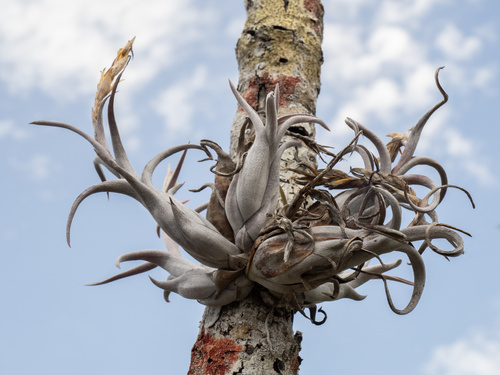
Its native range includes the southern United States, explicitly including Florida, central and southern Mexico, Central America, Venezuela, Colombia, and the West Indies or Antilles. It is reported to grow epiphytically on trees in mangroves, forest-edge scrub, deciduous forest, dry forest, and Pacific regions; populations in southwestern Florida are reported to grow mainly on southern pine but are not host-specific. Its distribution extends from warm-temperate to tropical regions, while the genus Tillandsia occurs in environments including forests, deserts, and mountains.
Characteristics
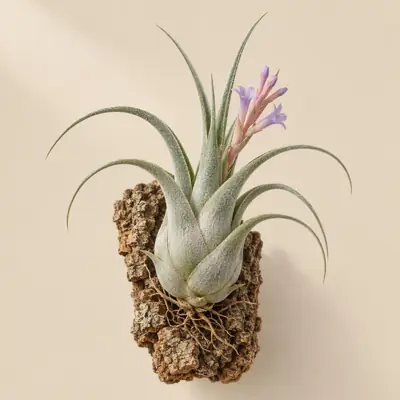
It is reported to have pale green to silvery-gray, short, tapering leaves densely covered with conspicuous scales; another account describes the blades as inward-rolled and awl-shaped. Sources differ on the flowers, describing colors from pale pink to lavender-blue or purple; the inflorescence may be simple, finger-like, or a short pinnately compound form. Few-source reporting places mature height at about 10–40 cm. The plant is reported to have capsule fruits and silvery, dense trichomes.
Light
Sources differ on light guidance, but describe primarily bright conditions, with more sun in spring, autumn, and winter and bright shade in summer; indoor plants generally require relatively high light to flower successfully. Bright indirect light is generally reported as the light level.
Watering
Sources differ on watering details; the hair-like leaf scales are important for water absorption, and indoor plants need regular watering with good airflow and drainage, while outdoor water needs vary with conditions. After soaking, water should be removed from the base and between the leaves so the plant can dry quickly. A generally reported method is to soak, then let dry.
Humidity and airflow
Tillandsia paucifolia is generally reported to need good airflow.
Growing medium and mounting
It generally does not require soil and is reported to grow suspended or attached to surfaces such as wood, bark, cork, or rock. Its generally reported preference is to be mounted.
Feeding
It is reported to require little to no feeding; general Tillandsia cultivation information from NHK gives separate feeding guidance only for some potted kinds.
Propagation
It is reported to be propagated from offsets formed after flowering, which can be separated after they have developed sufficiently in size or foliage. Propagation from seed is also reported to be possible, but growth from seed is very slow.
Common problems
Tillandsia in general is reported to be susceptible to scale insects, spider mites, and mealybugs, as well as sooty mold and crown rot; sooty mold may be associated with scale-insect excretions. Brown, crisp leaf tips are reported to be associated with insufficient water, while prolonged standing water at the base or between leaves may lead to rot; standing water should be avoided after watering and good airflow maintained. Tillandsia in general is reported to tolerate heat well but to have ordinary to relatively weak cold tolerance, with strong direct sunlight avoided during summer cultivation.
Identification
Tillandsia paucifolia is reported to have a large, swollen, flask-shaped base that is an important feature for distinguishing it from other Tillandsia. Its leaves are reported to bear especially large and abundant scales that increase the surface area available for absorbing water and nutrients from the air.
Photos


Sources
- Wikipedia (en): Tillandsia paucifolia — CC BY-SA 4.0 · link
- Wikipedia (es): Tillandsia paucifolia — CC BY-SA 4.0 · link
- USDA PLANTS Database: Tillandsia paucifolia — Public domain (US Government work) · link
- Rainforest Flora care guide: Tillandsia (group-level) — © Rainforest Flora, facts only · link
- NHK みんなの趣味の園芸 植物図鑑: Tillandsia (genus-level) — © NHK出版, facts only · link
- NC State Plant Toolbox: Tillandsia (genus-level) — copyright (facts only) · link