
Silvery Wild Pine (Tillandsia streptophylla)
Tillandsia streptophylla is an evergreen, rosette-forming air plant that commonly grows as an epiphyte. It is perennial; an individual rosette gradually declines after flowering and can produce offsets that continue growth.
Watch: 25 Air Plants: No Soil, Seriously
Overview
Tillandsia streptophylla is an evergreen, rosette-forming air plant that commonly grows as an epiphyte. It is perennial; an individual rosette gradually declines after flowering and can produce offsets that continue growth.
Origin and habitat
Sources differ on its native range: it occurs from Mexico and Central America to the West Indies, with accounts specifically including the Bahamas, Cuba, the Cayman Islands, and the Turks and Caicos Islands, while other accounts describe ranges extending from Mexico to Nicaragua or Honduras and Jamaica. Tillandsia species are reported to grow mainly as epiphytes on trees but can also grow on rocks or cliffs, using their roots for anchorage and absorbing most water and nutrients through scales on their leaves. Its native distribution lies in Mexico, Central America, and parts of the Caribbean, while the genus Tillandsia as a whole occurs in tropical to warm-temperate environments.
Characteristics
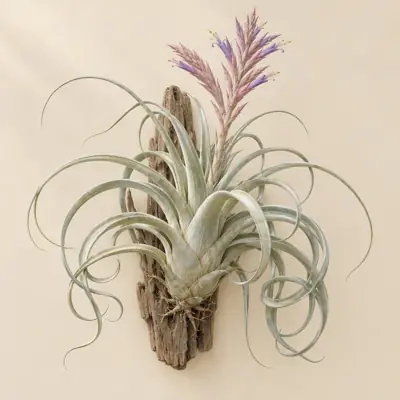
Sources differ on mature height, with the few available accounts indicating about 20–45 cm. Mature spread is 10–50 cm. The numerous leathery leaves are reported to be linear to narrowly triangular, gray-green to silvery white, and densely covered with scales; they curl downward or backward and twist, with curling becoming more pronounced when dry, while the tapering tips may become intertwined. It is reported to produce an upright, branched compound inflorescence from the center, with bracts ranging from pink, pale green, and pale purple to pale peach, and purple tubular flowers whose stamens may extend beyond the petals.
Light
Sources differ in their descriptions of light: a bright, well-ventilated setting is indicated, while RHS recommends a full-sun position and bright light in a greenhouse, and Tillandsia generally requires relatively high light levels when grown indoors. It is generally described as preferring bright indirect light.
Watering
Sources differ on watering details: from spring through autumn, the plant may be immersed in rainwater to absorb water thoroughly, with watering increased in hot, dry conditions; afterward it should drain thoroughly with good ventilation so that water does not remain trapped for long periods. Soak, then let dry. It is reported to require drying promptly after watering.
Humidity and airflow
It is reported to need good airflow.
Temperature and dormancy
It is generally classified as RHS H1C. It is reported to be frost tender; keep above freezing.
Growing medium and mounting
As an air plant, it is reported generally not to require ordinary potting soil and can be hung or attached to materials such as wood, bark, cork, or rock. It is generally grown mounted.
Feeding
Tillandsia generally is reported to require little or no feeding in cultivation.
Propagation
It can be propagated from seed or by separating offsets once they have reached a substantial fraction of the parent plant's size.
Common problems
Tillandsia streptophylla may be affected by aphids and mealybugs, while scale insects and leaf mites are also recorded for Tillandsia generally. RHS describes this species as generally having few disease problems, while general Tillandsia information also records crown rot and sooty mold as possible problems. When short of water, leaf tips may become dry and brown and the leaves may curl more than usual; if water remains in the center or between leaves after watering and dries too slowly, rot may occur.
Identification
It is reported to be a large, vase-shaped air plant with broad leaf sheaths forming a conspicuous pseudobulb and silvery-gray, densely scaled leaves characterized by strong curling and twisting; the degree of leaf curling changes with water availability.
Photos


Sources
- Wikipedia (en): Tillandsia streptophylla — CC BY-SA 4.0 · link
- Wikipedia (ja): チランジア・ストレプトフィラ — CC BY-SA 4.0 · link
- RHS Plants: Tillandsia streptophylla — © RHS, facts only · link
- Rainforest Flora care guide: Tillandsia (group-level) — © Rainforest Flora, facts only · link
- NHK みんなの趣味の園芸 植物図鑑: Tillandsia (genus-level) — © NHK出版, facts only · link
- NC State Plant Toolbox: Tillandsia (genus-level) — copyright (facts only) · link