
bluewings (Torenia fournieri)
Torenia fournieri is a low-growing, compact, clump-forming annual herb with upright to ascending stems.
Overview
Torenia fournieri is a low-growing, compact, clump-forming annual herb with upright to ascending stems.
Origin and habitat
Sources differ on its native range: Vietnam is recorded, while broader accounts give China and Indochina, South Asia to Southeast Asia, or Asia. It is recorded from forest habitat and is also widely cultivated as an ornamental plant.
Characteristics
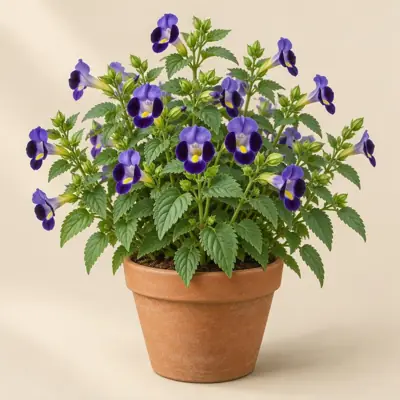
Sources differ on mature height, placing it at about 10–50 cm. A single source reports a mature spread of about 10–50 cm. Sources differ in describing the pale green to green, simple leaves as opposite or nearly opposite with serrated margins, and as stalked and triangular-lanceolate or, more generally, ovate. The corolla is lip-shaped to trumpet-shaped, commonly blue, purple, pink, or white with a yellow throat or markings, while yellow forms also occur; the upper lip is divided and the lower lip is three-lobed. Sources differ on flowering season, describing flowering mainly from summer to autumn, while Taiwan agricultural information also records flowering across spring, summer, and autumn; a single source reports that the plant sets seed, which can be collected in late autumn or may fall naturally when mature.
Light
Sources differ in describing light needs as ranging from full sun to partial sun, with some shade advisable during hot summers to avoid leaf yellowing or discoloration from intense sun.
Watering
Keep the soil moist but well drained; water needs increase during vigorous growth, while drought or interruption of watering can affect growth.
Growing medium and mounting
It grows in fertile, moist but well-drained soil; the RHS recommends slightly acidic fertile soil but also lists acidic, neutral, and alkaline soils, including loam, clay, sand, and chalk.
Feeding
Fertilizer should be supplied during growth; Taiwan agricultural information recommends incorporating organic fertilizer into the soil and applying additional fertilizer regularly, while the RHS recommends continued use of a suitable general plant fertilizer during the growing period.
Propagation
Torenia fournieri can be propagated from seed or by stem cuttings, and root disturbance should be minimized when transplanting seedlings.
Common problems
It is reported to be susceptible to damage from slugs, snails, and aphids, and to root rot and powdery mildew. Intense sun can cause leaf yellowing or discoloration, drought or interrupted watering can affect growth, and plants may also become leggy. It is relatively sensitive to cold and can tolerate high summer temperatures, although intense sunlight in hot conditions may damage the leaves; the RHS also gives it a low hardiness rating.
Identification
Torenia fournieri can be recognized by a corolla with a conspicuous yellow throat or spots, wishbone-shaped stamens, toothed leaf margins, and flowers that commonly combine colors such as purple and white.
Photos


Sources
- Wikipedia (en): Torenia fournieri — CC BY-SA 4.0 · link
- Wikipedia (de): Fournier-Torenie — CC BY-SA 4.0 · link
- GBIF descriptions: The checklist of alien seed plants of D.R. Congo, based on evidence from herbarium collections; List — per dataset · link
- NC State Plant Toolbox: Torenia fournieri — copyright (facts only) · link
- 農業知識入口網 植物圖鑑: Torenia fournieri — © MOA, facts only · link
- RHS Plants: Torenia fournieri — © RHS, facts only · link
- USDA PLANTS Database: Torenia fournieri — Public domain (US Government work) · link