
Waxy Spiderwort (Tradescantia cerinthoides)
Tradescantia cerinthoides is a perennial herb with generally succulent, usually upright stems that branch relatively little and may branch from the base; it can grow terrestrially or on rocks and, less commonly, as an epiphyte. It is reported to be perennial.
Overview
Tradescantia cerinthoides is a perennial herb with generally succulent, usually upright stems that branch relatively little and may branch from the base; it can grow terrestrially or on rocks and, less commonly, as an epiphyte. It is reported to be perennial.
Origin and habitat
Sources differ on its native range, which is described as South American, including Argentina, Brazil, and Uruguay, with Brazilian records from Minas Gerais, São Paulo, Paraná, Santa Catarina, and Rio Grande do Sul. It is reported from ecological regions including the Atlantic Forest, Cerrado, Chaco, and Pampa, and can occur in sunny or shaded grassland as well as on rocks, on land, in dunes, and in restinga coastal vegetation of southern Brazil.
Characteristics
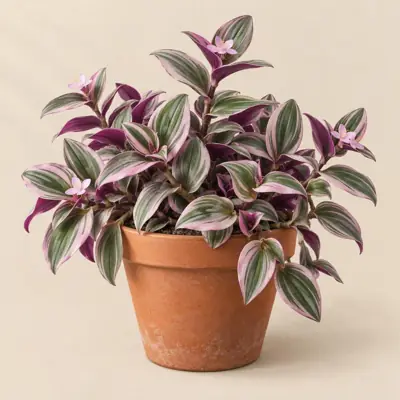
Mature plants range from 10 cm to 60 cm in height. The sessile leaves are reported to be alternately arranged to spirally alternate, generally succulent, and variable from elliptic and ovate to obovate, with surfaces ranging from light to dark green and sometimes bearing burgundy stripes, undersides ranging from green to burgundy, and often soft, coarse, or glandular hairs. Flowers have petals ranging from white or white with pink tips to pale pink, pink, or pale purple; the inflorescences may occur at stem tips or in upper leaf axils, and white flowers with pink tips are among its ornamental features. The fruit is reported to be a capsule, and the seeds have a medium-gray to dark-gray seed coat.
Light
Bright, indirect light is suitable; Tradescantia can tolerate full sun, but strong afternoon sun is best avoided to reduce the risk of leaf scorch, while wild Tradescantia cerinthoides can also grow in full sun or shade.
Watering
The growing medium is generally kept moderately moist but well drained, allowing the surface layer to dry before watering again and avoiding prolonged waterlogging.
Temperature and dormancy
A minimum temperature threshold is reported for Tradescantia cerinthoides.
Growing medium and mounting
It is reported to prefer moist, well-drained, acidic, humus-rich soil or potting medium.
Propagation
It is reported to be propagated by stem cuttings, leaf cuttings, or division, with stem nodes rooting readily.
Common problems
In cultivation, Tradescantia is reported to be susceptible to spider mites, aphids, thrips, and mealybugs, while snails, slugs, and caterpillars may also damage young shoots. Poor drainage and waterlogging are reported to be associated with root rot, while cool, damp conditions may be associated with gray mold on leaves and flowers. Excessively strong direct sunlight may scorch leaves, while waterlogging and poor drainage may cause root rot; some Tradescantia can become weedy or invasive under suitable conditions. Tropical and subtropical Tradescantia are reported to be sensitive to low temperatures, and strong afternoon sun may scorch the leaves; outdoor plants are generally moved indoors as temperatures approach a low-temperature threshold.
Identification
Tradescantia cerinthoides is a succulent herb whose stems may have reddish-purple longitudinal stripes; its leaves can be green, burgundy-striped, or burgundy beneath, and its petals range from white or white with pink tips to pink or pale purple.
Photos


Sources
- GBIF Backbone: Tradescantia cerinthoides Kunth — CC BY 4.0 · link
- Wikipedia (en): Tradescantia cerinthoides — CC BY-SA 4.0 · link
- GBIF descriptions: Wandering throughout South America: Taxonomic revision of Tradescantia subg. Austrotradescantia (D. — per dataset · link
- NC State Plant Toolbox: Tradescantia (genus-level) — copyright (facts only) · link