
Didier's tulip (Tulipa gesneriana)
Tulipa gesneriana is a perennial bulbous herbaceous plant.
Overview
Tulipa gesneriana is a perennial bulbous herbaceous plant.
Origin and habitat
Sources differ on its origin: it is of cultivated origin, its exact wild source is unknown, and multiple accounts associate its development with ancient, complex hybridization involving wild tulip groups from temperate regions of Europe to Asia. It occurs in and around cultivated sites, gardens, and parks, with records of escapes or naturalized plants in grassland, woodland edges, and woodland. It is adapted to temperate cultivation with a cold period, which supports subsequent growth and flowering, and its bulbs are cold tolerant.
Characteristics
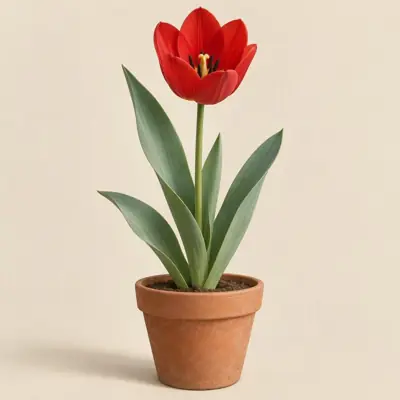
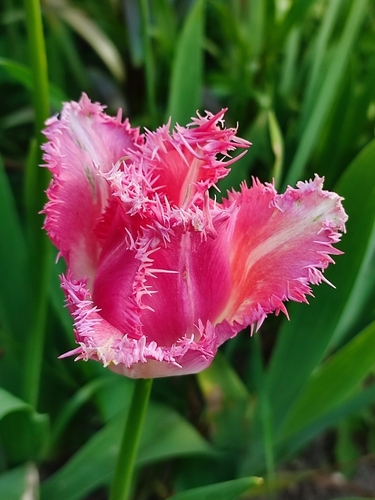
Sources differ on mature height, placing it at about 10–50 cm, while a single source reports a mature spread of about 10–50 cm. Leaves range from green to blue-green and are often ovate-lanceolate, oblong-lanceolate, or broadly lanceolate, with generally smooth surfaces. Flowers are usually solitary at the tips of upright flowering stems, may be broadly bell-shaped or cup-shaped, and cultivated types vary widely in flower color, including red, orange, yellow, white, pink, purple, and multicolored forms. Sources differ on flowering time, but describe flowering in spring, with timing varying by cultivar group and growing location.
Light
Tulipa gesneriana grows in full sun.
Watering
The soil should be moist but well drained, avoiding waterlogging and especially excessive winter wetness.
Temperature and dormancy
A single source reports cold tolerance to about -12 °C, and also reports a high RHS hardiness rating. Tulipa gesneriana is frost hardy.
Growing medium and mounting
It grows in fertile, well-drained soil and has been cultivated in chalk, clay, loam, and sand, under acidic, neutral, or alkaline conditions; leaf mold can be added to sandy soil for improvement.
Feeding
A single source reports that liquid fertilizer may be used if needed during the first growing season of young plants.
Propagation
Tulipa gesneriana can be propagated from seed or by separating small offset bulbs in summer.
Common problems
A single source reports common pests listed for the genus Tulipa, including slugs, snails, bulb mites, Narcissus bulb fly, and aphids. A single source reports that mosaic-type viral infections can cause distinctive stripes or flame-like markings on flowers and may weaken plants and bulbs. Excessively wet winter soil is unfavorable for cultivation, and viral infection can cause abnormal flower coloration and weaken plants. The bulbs are cold tolerant, while cultivation sites should be sheltered from strong winds and excessive winter wetness.
Identification
Tulipa gesneriana has an underground bulb, upright flowering stems usually bearing a solitary terminal flower, and mostly lanceolate leaves; cultivated forms show great diversity in flower color and shape.
Photos


Sources
- Wikipedia (en): Tulipa gesneriana — CC BY-SA 4.0 · link
- 維基百科:郁金香 — CC BY-SA 4.0 · link
- Wikipedia (de): Garten-Tulpe — CC BY-SA 4.0 · link
- Wikipedia (fr): Tulipa gesneriana — CC BY-SA 4.0 · link
- Wikipedia (es): Tulipa gesneriana — CC BY-SA 4.0 · link
- GBIF descriptions: Manual of the Alien Plants of Belgium; Database of Vascular Plants of Canada (VASCAN); DAISIE - Inve — per dataset · link
- Wikipedia (nl): Tulipa gesneriana — CC BY-SA 4.0 · link
- Useful Tropical/Temperate Plants: Tulipa gesneriana — CC BY-NC-SA 3.0 (facts only) · link
- RHS Plants: Tulipa gesneriana — © RHS, facts only · link
- USDA PLANTS Database: Tulipa gesneriana — Public domain (US Government work) · link
- NC State Plant Toolbox: Tulipa (genus-level) — copyright (facts only) · link