
Oukoe Butterbush (Tylecodon reticulatus)
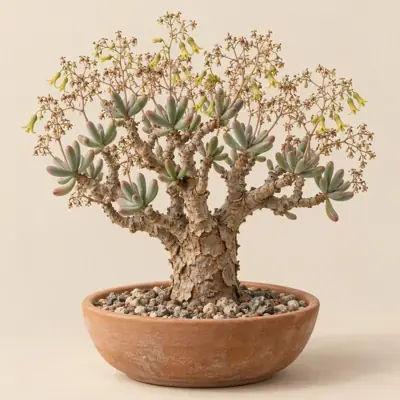
Tylecodon reticulatus is a compact, shrubby plant with succulent stems, typically with a single thick, short basal stem and a rounded to nearly hemispherical, branching crown.
Overview
Tylecodon reticulatus is a compact, shrubby plant with succulent stems, typically with a single thick, short basal stem and a rounded to nearly hemispherical, branching crown.
Origin and habitat
It is native to southern Africa, including southern Namibia and the Northern Cape and Western Cape of South Africa, extending into Namaqualand, the Little Karoo, and the western Great Karoo. It grows in dry, rocky coastal and mountainous habitats and quartz-gravel areas, sometimes in quartz-rich sandy loam, and is associated with South African Succulent Karoo habitats. It is adapted to arid southern African conditions, with winter growth and summer dormancy.
Characteristics
Mature plants are 3–38 cm tall; sources differ on mature spread, placing it at about 30–60 cm. Growth is reported to be very slow, and the plant has a swollen stem. Sources describe the fleshy leaves differently: they are clustered at the branch tips and held upright to obliquely upward, are gray-green to blue-green and may show a marked pink tinge, and have been described as ovate, linear-lanceolate, linear-oblanceolate, nearly cylindrical, or spindle-shaped, with smooth or hairy surfaces. Sources differ in their descriptions of the flowers: the delicate, much-branched cymose inflorescences bear upright to spreading flowers with yellow-green, sometimes brown-tinged, tubular to nearly urn-shaped corollas whose lobes spread outward and gradually reflex; flowering is reported in winter, and capsules containing extremely small seeds are formed.
Light
It is reported to grow and flower in full sun or partial sun.
Watering
During its growth period from around late summer to early spring, water when the mix is nearly dry; during dormancy from late spring through summer, withhold or greatly reduce water. A single specialist source reports a winter watering interval of about 14 days, so sources are few. It is generally recommended that, while in leaf, water when the mix has dried and withhold water while leafless.
Temperature and dormancy
Sources differ on the minimum temperature, with limited evidence placing it at about 5 °C; a single specialist source reports about 8 °C as ideal. It is frost tender; keep above freezing. It is reported to drop its leaves and go dormant, with dormancy triggered by heat. A single specialist source reports a cold minimum of about 5 °C, so sources are few.
Growing medium and mounting
It is reported to need a very fast-draining mix; in the ground, sand or well-drained sandy loam can be used, while container mixes may combine mature compost or fine bark with river sand, silica sand, or pumice, or use a well-drained cactus mix.
Feeding
It is reported not to necessarily require feeding because it is adapted to poor soils; container plants may receive a moderate amount of diluted high-potassium fertilizer during growth, and slow-release fertilizer may also be added when repotting.
Propagation
It is reported to be propagated from seed, with mature seed collected and sown when it can be readily removed from the capsule, or by cuttings taken in late autumn. Seedlings are reported to be suitable for transplanting in their second or third year.
Common problems
It is reported to be susceptible to mealybugs, a type of scale insect. Leaves are reported to drop readily under cold conditions. Planting too deeply is reported to be unsuitable for the swollen stem; a source recommends burying only the roots, keeping the narrower neck near the surface, and giving particular attention to drainage.
Identification
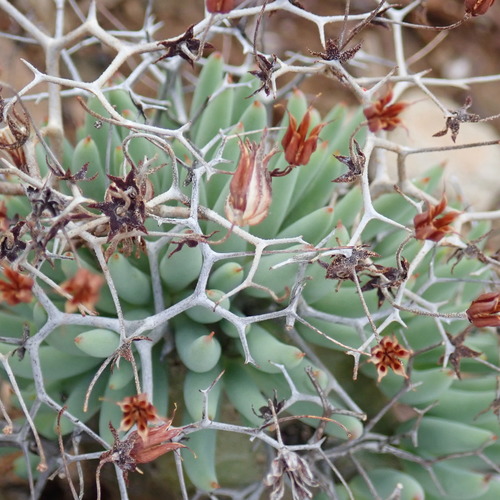
After flowering, the dried inflorescences remain at the branch tips for a long time, accumulating into a dense, spiny-looking, net-like framework above the branches and foliage. The thick main trunk has gray-brown to pale brown bark that peels in papery or strip-like pieces.
Photos


Sources
- Wikipedia (en): Tylecodon reticulatus — CC BY-SA 4.0 · link
- Wikipedia (de): Tylecodon reticulatus — CC BY-SA 4.0 · link
- LLIFLE Encyclopedia of living forms: Tylecodon reticulatus — CC BY-SA · link
- Desert-Tropicals: Tylecodon reticulatus — © Philippe Faucon (desert-tropicals.com), facts only · link
- PUKUBOOK: Tylecodon reticulatus — CC BY-NC (facts only) · link