Pegleg Butterbush (Tylecodon wallichii)
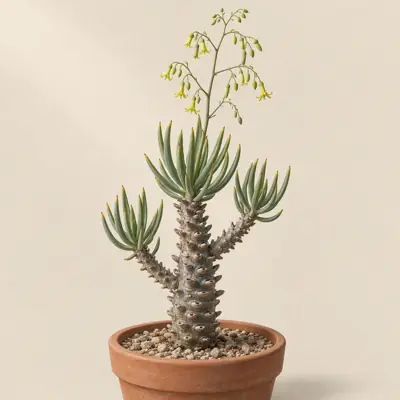
Tylecodon wallichii is a low, sparsely branched succulent shrub with a single thick, woody, often warty fleshy main stem.
Overview
Tylecodon wallichii is a low, sparsely branched succulent shrub with a single thick, woody, often warty fleshy main stem.
Origin and habitat
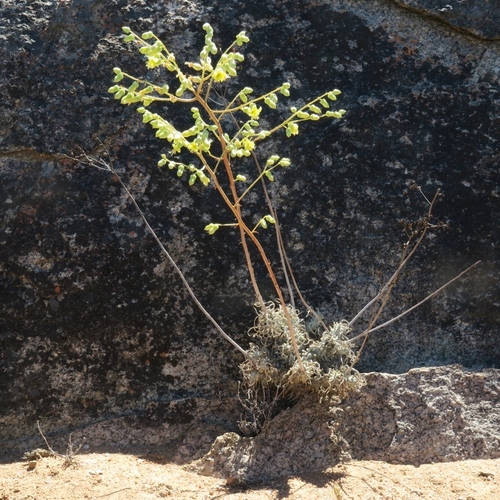
Tylecodon wallichii is native to southern Africa, occurring in southern Namibia and South Africa from Namaqualand through the Great Karoo and Little Karoo, with South African records in the Northern Cape and Western Cape. Sources differ in describing its habitat as gravelly or sandy slopes and rocky ridges. It is reported to be adapted to arid parts of southern Africa, growing in winter and becoming dormant in summer.
Characteristics
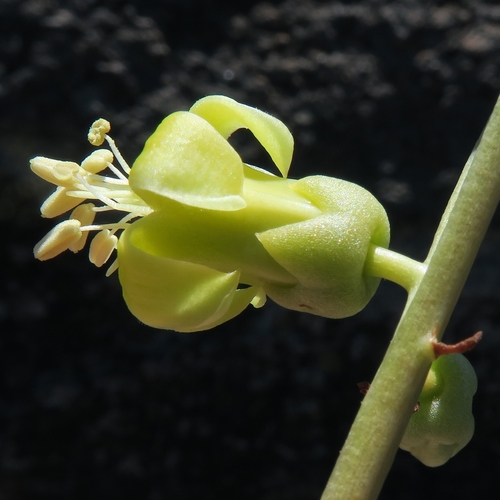
Mature plants reach 50–100 cm in height and have a swollen stem. Growth is reported to be very slow; the thick main stem and overall plant can become substantial in size. The leaves are clustered near branch tips, yellow-green to gray-green, hairless and narrow, growing upward with a slight inward curve, a tapering tip and sometimes a shallow groove on the upper surface; they appear in winter and fall in summer. The flowers are reported to be yellow to yellow-green, with tubular to urn-shaped corollas and spreading to pendent individual flowers whose lobes spread or curve backward in clustered inflorescences; flowering is reported in summer, and the plant is also reported to form seed-bearing capsules from which mature, readily detachable seeds can be collected.
Light
It is reported to suit full sun and can also grow and flower in partial sun.
Watering
It is reported to grow in winter: water may be supplied from late summer to early spring, allowing the roots to become nearly dry before watering during growth, while water should be withheld or conditions kept dry during dormancy from late spring through summer. Sources are few, but reported summer watering intervals are about 21–60, while the reported winter interval is about 14. Generally, while in leaf, water when the mix has dried, and withhold water while leafless.
Temperature and dormancy
Sources differ on a minimum around 5 °C. It is generally frost tender; keep above freezing, with limited-source guidance placing the cold minimum at about 5 °C. It is reported to drop its leaves and go dormant, with dormancy triggered by heat.
Growing medium and mounting
It is reported to need a very fast-draining mix; outdoors, sandy soil or well-drained sandy loam can be used, while containers may use well-rotted compost or fine bark combined with drainage materials such as river sand, silica sand or pumice, or a well-drained cactus mix.
Feeding
It is reported to have low fertilizer requirements; container plants may receive a moderate amount of diluted high-potassium fertilizer during growth, and slow-release fertilizer may be added to repotting medium.
Propagation
It is reported to be propagated by sowing mature seed promptly, with germination usually not difficult, or by cuttings taken in late autumn; seedlings can be transplanted after they have grown for several years.
Common problems
It is reported to be susceptible to mealybugs. Poor drainage or continued watering during summer dormancy does not match the reported cultivation requirements, and leaves are reported to fall readily in cold conditions. Cold conditions are reported to promote leaf drop, with warmer winter conditions preferred.
Identification
Tylecodon wallichii can be recognized by its thick, knobbly or warty main stem, branches densely covered with persistent leaf bases called phyllopodia, and leaves clustered near the branch tips.
Photos