
dwarf bulrush (Typha minima)
Typha minima is a perennial, rhizomatous, clump-forming herb of emergent aquatic to wetland habitats.
Overview
Typha minima is a perennial, rhizomatous, clump-forming herb of emergent aquatic to wetland habitats.
Origin and habitat
Typha minima is native to temperate parts of Europe and Asia, including the Alps, Apennines, Balkans, Danube region, Central Asia, Turkey, Mongolia, China, and Pakistan. It occurs along rivers and lakes, in shallow water, marshes, ponds, ditches, and other periodically flooded wetlands, particularly in slower-moving waters and on gravelly or alluvial river margins. Its temperate Eurasian habitats include riparian wetlands shaped by periodic flooding and changing water levels.
Characteristics
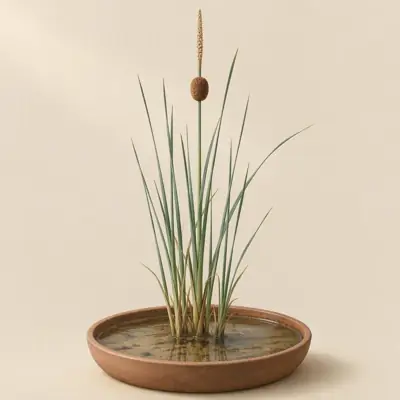
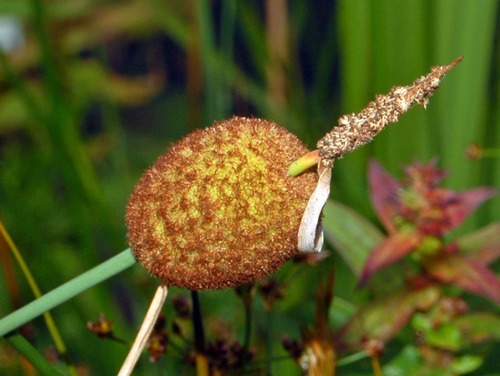
Sources differ on mature height, placing it at about 30–140 cm, while a single source reports a mature spread of about 10–50 cm. Sources differ in their descriptions of leaf dimensions and flowering period; the leaves are blue-green to green, linear, narrow, and not glossy, while flowering is mainly from late spring to early summer, with other accounts describing an earlier start, possible repeat flowering later, or mid- to late-summer flowering under horticultural conditions. The plant is monoecious with separate unisexual inflorescences: the yellowish male inflorescence is above the greenish female one with a bare stem section between them, and the mature female inflorescence is brown and elliptical to ovoid; pollination is by wind. A single source reports that after flowering the female inflorescence develops into a brown, nearly round to ovoid fruiting spike whose seeds can disperse by wind.
Light
Full sun is preferred; field ecological sources describe Typha minima as light-demanding and intolerant of shade.
Watering
Keep the root zone persistently wet or in shallow water; it can grow at muddy pond margins or in shallow water and also tolerates periodic flooding in the wild.
Growing medium and mounting
Fertile, muddy, poorly drained loam or clay is suitable, while wild habitats also include gravelly river margins and calcareous environments; horticultural information indicates that acidic, neutral, or alkaline soils are suitable.
Propagation
Typha minima can reproduce vegetatively by rhizomes and can be divided in spring in cultivation; in the wild it can also spread by seed and drifting rhizome fragments.
Common problems
It is generally reported to have few pest or disease problems. Without flooding, water-level fluctuations, or other disturbances that maintain open habitat, wild populations may be displaced through vegetation succession by taller competing plants such as sedges or reeds; in cultivation, uncontrolled rhizome expansion can also create management problems. It is sensitive to shade, and its habitat depends on periodic flooding or water-level disturbance to maintain suitable open wetland conditions.
Identification
Typha minima is reported to be notably small within its genus, with very narrow leaves, short brown female fruiting spikes that are nearly spherical to elliptical, and a conspicuous bare stem section between the male and female inflorescences.
Photos


Sources
- Wikipedia (en): Typha minima — CC BY-SA 4.0 · link
- 維基百科:小香蒲 — CC BY-SA 4.0 · link
- Wikipedia (de): Zwerg-Rohrkolben — CC BY-SA 4.0 · link
- Wikipedia (fr): Typha minima — CC BY-SA 4.0 · link
- GBIF descriptions: Manual of the Alien Plants of Belgium; DAISIE - Inventory of alien invasive species in Europe; Globa — per dataset · link
- Useful Tropical/Temperate Plants: Typha minima — CC BY-NC-SA 3.0 (facts only) · link
- RHS Plants: Typha minima — © RHS, facts only · link