
Chinese elm (Ulmus parvifolia)
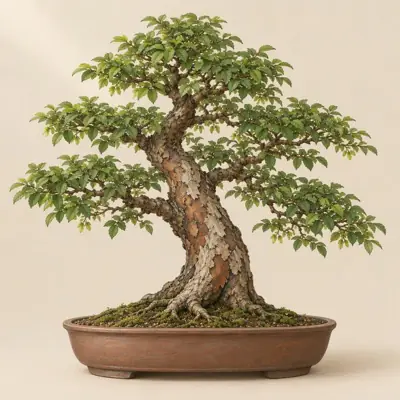
Ulmus parvifolia is a tree with a crown that may be rounded, spreading, or broadly rounded, and its branches may droop. It is perennial, while sources differ in describing it as deciduous, semi-deciduous, or semi-evergreen depending on climate.
Overview
Ulmus parvifolia is a tree with a crown that may be rounded, spreading, or broadly rounded, and its branches may droop. It is perennial, while sources differ in describing it as deciduous, semi-deciduous, or semi-evergreen depending on climate.
Origin and habitat
Sources differ on its native range: it is native to Asia, centered on regions of East and Southeast Asia including China, Japan, the Korean Peninsula, Taiwan, and Vietnam or Indochina, while some sources also include India, Siberian Russia, and Kazakhstan. It occurs in plains, hills, sloping valleys, and along rivers, and is often associated with waterside sites or fertile, moist soils. Sources describe its bonsai cultivation habit as subtropical, although it can also be grown in cooler regions, with foliage behavior varying with climate from deciduous to semi-evergreen.
Characteristics
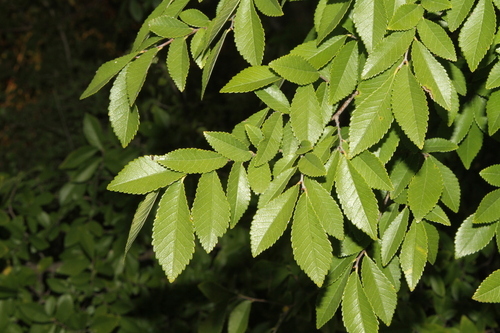
Sources differ on mature height, placing it at about 1200–2500 cm; sources are also few for mature spread, which is reported at about 1500–2000 cm. It grows rapidly and has small, alternate simple leaves that may be leathery and glossy, with shapes ranging from narrowly elliptic and oblong to ovate or obovate, often with an asymmetric base and serrated margins; sources differ in their leaf descriptions, and the foliage may turn yellow, red, or purplish red in autumn. The small, inconspicuous, bisexual, wind-pollinated flowers are often borne in clusters and are described as pale yellow, yellow, greenish white, or reddish brown, appearing from late summer into autumn and mainly in early autumn. The fruit is a winged samara, usually elliptic to ovate-elliptic, and matures in late autumn.
Light
Ulmus parvifolia grows in full sun to partial sun; bonsai kept indoors require a very bright environment.
Watering
It is suited to well-drained soil and grows well in moist, fertile soil, while also adapting to drier locations or moist sites.
Temperature and dormancy
A single source reports a minimum temperature of about -5 °C, so sources are few.
Growing medium and mounting
Well-drained soil is suitable; it can adapt to loam, sandy, and calcareous soils across acidic, neutral, or alkaline conditions, with fertile, moist loam being particularly suitable.
Propagation
It can be propagated from seed, as well as by summer softwood cuttings, budding, or grafting; NC State identifies seed as a good propagation method.
Common problems
Potential pests include aphids, bark beetles, elm leaf beetles, elm sawflies, elm lace bugs, leaf miners, elm gall mites, and scale insects. It has relatively strong resistance to Dutch elm disease, but coral spot, Armillaria-related disease, and Phytophthora-related disease may still occur, and another source reports greater susceptibility to elm yellows. Young trees may develop multiple main trunks that require pruning and organization, while damage to large branches can leave conspicuous wounds. Branches may break under snow, ice, or strong-wind stress, and the root ball of bonsai requires protection from freezing in winter.
Identification
Distinctive features include small serrated leaves, autumn flowering, and mature trunks with bark that peels in patches to reveal mottled gray, brown, orange-brown, or reddish-brown coloration.
Photos



Sources
- Wikipedia (en): Ulmus parvifolia — CC BY-SA 4.0 · link
- 維基百科:榔榆 — CC BY-SA 4.0 · link
- Wikipedia (ja): アキニレ — CC BY-SA 4.0 · link
- Wikipedia (de): Chinesische Ulme — CC BY-SA 4.0 · link
- Wikipedia (fr): Orme de Chine — CC BY-SA 4.0 · link
- Wikipedia (es): Ulmus parvifolia — CC BY-SA 4.0 · link
- GBIF descriptions: Database of Vascular Plants of Canada (VASCAN) — per dataset · link
- NC State Plant Toolbox: Ulmus parvifolia — copyright (facts only) · link
- TaiCOL 臺灣物種名錄: Ulmus parvifolia — CC BY 4.0 · link
- Useful Tropical/Temperate Plants: Ulmus parvifolia — CC BY-NC-SA 3.0 (facts only) · link
- RHS Plants: Ulmus parvifolia — © RHS, facts only · link
- USDA PLANTS Database: Ulmus parvifolia — Public domain (US Government work) · link