
Mousetrap tree (Uncarina grandidieri)
Uncarina grandidieri is a semi-succulent deciduous shrub to small tree with a swollen basal structure and stout stems that thicken with age. It is perennial; sources differ on its seasonal behavior, but it is generally described as entering dormancy and dropping its leaves in winter.
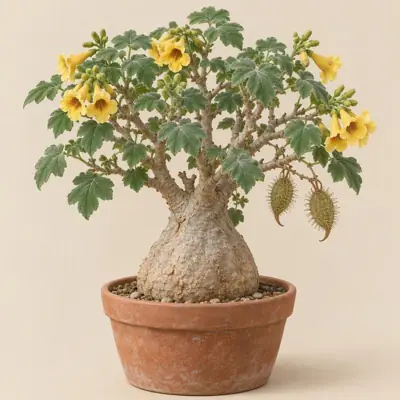
Overview
Uncarina grandidieri is a semi-succulent deciduous shrub to small tree with a swollen basal structure and stout stems that thicken with age. It is perennial; sources differ on its seasonal behavior, but it is generally described as entering dormancy and dropping its leaves in winter.
Origin and habitat
Uncarina grandidieri is native to Madagascar, with one source further restricting its native range to southern Madagascar. Its habitat includes dry forest, desert, or dry scrub environments. It is native to dry environments in tropical Madagascar, favors warmth and tolerates high temperatures during growth, and can become dormant under cooler, dry conditions in winter.
Characteristics
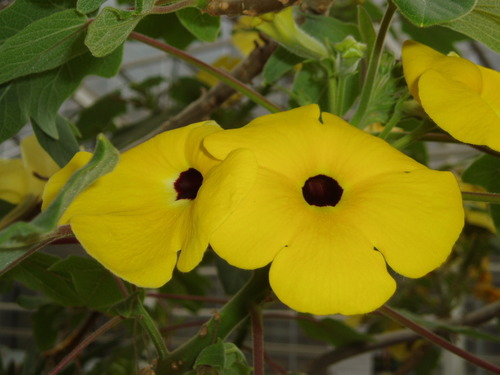
Sources differ on mature height, placing it at about 300–750 cm; the few available sources for spread report about 183–183 cm. It can grow rapidly when supplied with water, warmth, and ample root space, and seedlings are also described as vigorous and fast growing; it develops a thickened trunk (pachycaul) and can become a shrub or small tree with a substantial trunk or girth. The long-petioled, palmately lobed leaves are hairy and slightly sticky, may produce a musty or unpleasant odor when rubbed, are smaller on flowering branches, and are generally shed during winter dormancy; the large bright yellow flowers have a dark to purplish-red throat and a corolla resembling Petunia or Thunbergia, while sources differ on how long flowering can continue under warm conditions. The capsules are flat and pointed, with numerous projections bearing small recurved hooks that readily catch on animals or human fingers when dry.
Light
It grows in bright light to full sun and can also accept partial sun or bright shade.
Watering
During leafy growth it can be watered thoroughly or regularly, provided the growing medium drains well; while in leaf, water when the mix has dried. Water should be greatly reduced during winter or dormancy, and water should be withheld while leafless. Sources differ on winter watering frequency, with one figure around 14.
Temperature and dormancy
It is frost tender; keep above freezing, and it has high heat tolerance. A supported cold minimum is 2 °C, while sources differ on another reported minimum of about 2 °C. The few available sources report an upper temperature of about 45 °C. It drops its leaves and goes dormant; sources also differ on its reported hardiness classification.
Growing medium and mounting
A nutrient-rich, very well-drained growing medium can include pumice, volcanic rock, or perlite; other sources also recommend a gritty, well-drained succulent medium. One specialist source reports that it needs a very fast-draining mix.
Feeding
Young plants can receive diluted fertilizer to promote growth, while other sources advise that frequent feeding is unnecessary.
Propagation
Uncarina grandidieri can be propagated by seed or cuttings. Cuttings can be propagated under mist; nursery information describes plants from cuttings as generally flowering earlier, while seedlings are vigorous.
Common problems
One source reports that it can host geranium/tobacco budworm, whose larvae bore into tender stems and feed on flower buds and can cause extensive damage when severe. A specialist source reports that excessive moisture can lead to rot, particularly during dormancy or while the plant is leafless. The small hooks on mature fruit can readily pierce or catch on fingers. It tolerates high temperatures but is sensitive to frost and cold; freezing should be avoided, as should excessive moisture combined with low temperatures in winter.
Identification
Uncarina grandidieri is distinguished by its swollen caudex-like base, large yellow flowers with dark throats, and hook-covered fruits; compared with Uncarina decaryi, its leaves are more shallowly lobed and its flowers are larger.
Photos


Sources
- Wikipedia (en): Uncarina grandidieri — CC BY-SA 4.0 · link
- LLIFLE Encyclopedia of living forms: Uncarina grandidieri — CC BY-SA · link
- Desert-Tropicals: Uncarina grandidieri — © Philippe Faucon (desert-tropicals.com), facts only · link
- The Succulent Plant Page: Uncarina (genus-level) — © R.J. Hodgkiss, facts only · link
- Top Tropicals catalog: Uncarina grandidieri — © Top Tropicals LLC (facts only) · link
- Uncarina grandidieri | | plant lust (plantlust.com) — facts only (§12) · link
- PUKUBOOK: Uncarina grandidieri — CC BY-NC (facts only) · link
- Uncarina | Giromagi cactus and succulents | Buy plants online (www.giromagi.com) — facts only (§12) · link
- Uncarina Information - Learn About Propagating Uncarina Plants | Gardening Know (www.gardeningknowhow.com) — facts only (§12) · link