
highbush blueberry (Vaccinium corymbosum)
Vaccinium corymbosum is an upright, multi-stemmed, deciduous shrub and a perennial deciduous plant.
Overview
Vaccinium corymbosum is an upright, multi-stemmed, deciduous shrub and a perennial deciduous plant.
Origin and habitat
It is native to North America, mainly eastern Canada and the eastern and southern United States, with records extending from Ontario, Nova Scotia, and Newfoundland south to Florida, Texas, or Louisiana. Its natural habitats include moist, acidic woodlands, open areas, swamps, wet meadows, lake and stream banks, pine barrens, and some upland forests. It is suited to acidic environments with ample moisture and has some cold tolerance.
Characteristics
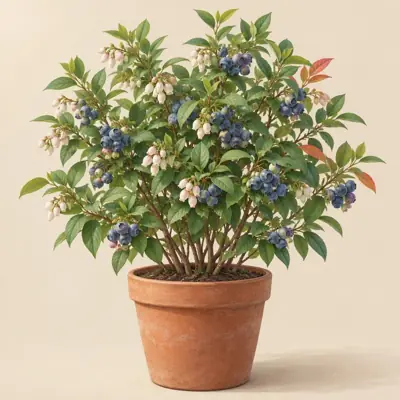
Sources differ on mature height, placing it at about 150–370 cm, while mature spread is 150–370 cm; growth is slow to moderate. Leaves are green to dark green and elliptic to oblong, turning red, orange, yellow, or purple in autumn before falling. The small white to pale pink flowers are bell-shaped, urn-shaped, or nearly cylindrical and appear in spring. The berries become blue to blue-black when mature and are nearly round; sources describe their size differently.
Light
It grows in full sun to partial sun, with better fruiting under more abundant sunlight.
Watering
It prefers consistently moist but well-drained soil and has low drought tolerance; its shallow roots make it sensitive to a steady moisture supply.
Temperature and dormancy
Sources differ, with the limited evidence placing the minimum temperature at about -25 °C.
Growing medium and mounting
It prefers acidic, moist but well-drained, lime-free soil, which may be loamy or sandy; sources differ on the preferred soil acidity.
Common problems
It is reported to be affected by scale insects, whiteflies, leafhoppers, leaf-rolling caterpillars, and blueberry bud mites, while deer may also browse the plant. It is reported to be susceptible to stem and twig blights, leaf diseases, Exobasidium leaf and fruit spot, Botrytis blossom and fruit rot, anthracnose fruit rot, and mummy berry disease. Lime in the soil or insufficient acidity can cause chlorosis, and drought is also unfavorable for growth. It has low drought tolerance, and sources recommend shelter from strong winds.
Identification
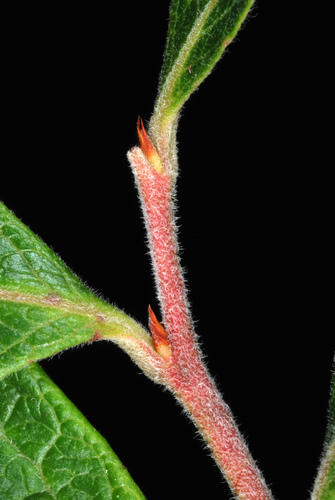
Vaccinium corymbosum is an upright, multi-stemmed deciduous shrub with white to pale pink urn-shaped flowers in spring, followed by blue to blue-black berries, and conspicuous red to purple autumn leaf coloration.
Photos


Sources
- Wikipedia (en): Vaccinium corymbosum — CC BY-SA 4.0 · link
- Wikipedia (de): Amerikanische Heidelbeere — CC BY-SA 4.0 · link
- Wikipedia (fr): Vaccinium corymbosum — CC BY-SA 4.0 · link
- Wikipedia (es): Vaccinium corymbosum — CC BY-SA 4.0 · link
- GBIF descriptions: Manual of the Alien Plants of Belgium; Database of Vascular Plants of Canada (VASCAN); DAISIE - Inve — per dataset · link
- NC State Plant Toolbox: Vaccinium corymbosum — copyright (facts only) · link
- Useful Tropical/Temperate Plants: Vaccinium corymbosum — CC BY-NC-SA 3.0 (facts only) · link
- RHS Plants: Vaccinium corymbosum — © RHS, facts only · link
- USDA PLANTS Database: Vaccinium corymbosum — Public domain (US Government work) · link