
blue orchid (Vanda coerulea)
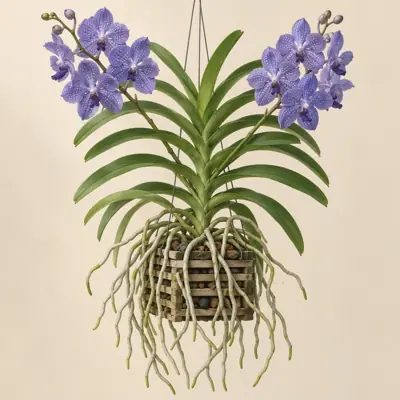
Vanda coerulea is a perennial, evergreen, monopodial epiphytic orchid with an upright habit and roots that can hang down from the stem.
Overview
Vanda coerulea is a perennial, evergreen, monopodial epiphytic orchid with an upright habit and roots that can hang down from the stem.
Origin and habitat
Sources differ on its native range, which is described as mainly including northeastern India, southern Yunnan in China, Myanmar, and northern Thailand. It grows epiphytically on tree trunks in riverside or montane open woodland and deciduous forest, and also occurs on exposed low-growing oaks, in habitats with a distinct winter dry season. Its habitat is tropical to subtropical and warm to cool montane, with relatively strong light and a winter dry season.
Characteristics
Sources differ on mature height, placing it at about 100–150 cm, while the few available sources report a mature spread of about 50–100 cm. The green to dark green leaves are arranged in ranks and are thickly leathery to leathery and strap-shaped. The large, waxy, nearly round flowers are pale blue to blue-purple, are long-lasting, and occur several to an inflorescence. Flowering is reported to occur in autumn.
Light
Vanda coerulea needs high light and can be grown in full sun to partial sun, with some shading from intense direct midday sun in summer.
Watering
During active growth it needs regular, ample watering, while its epiphytic roots should cycle rapidly between wet and dry conditions rather than remain waterlogged for long periods. In winter or when growth slows, reduce misting and watering without allowing prolonged complete dryness; it is generally best to let it dry between waterings. The few available sources report a winter watering interval of about 2–3.
Humidity and airflow
Vanda coerulea prefers high humidity; the few available sources report about 70–80 %. It needs good airflow.
Temperature and dormancy
Sources differ on the ideal temperature range, placing it at about 15–30 °C. The maximum temperature is 30 °C. It is generally described as cool-growing and is reported to have an H1A hardiness classification.
Growing medium and mounting
This epiphytic orchid can be grown bare-root in an open hanging basket or in a coarse, fast-draining epiphytic orchid medium based on bark. It has aerial roots with velamen.
Feeding
Apply orchid fertilizer regularly during vigorous growth, feeding from spring through autumn and reducing or stopping feeding as autumn advances or growth slows.
Propagation
Vanda coerulea can be propagated by separating side shoots or keikis produced by mature plants once they have developed new roots sufficiently for separation. Propagation from seed requires a controlled laboratory environment.
Common problems
Scale insects, mealybugs, and thrips may cause damage, and thrips can harm flowers and developing buds. Indoor conditions with insufficient light or humidity can impair growth and flowering; dry air can damage roots and cause leaf loss, while inadequate airflow increases the risk of rot. It has low cold tolerance, and during hot weather it requires a combination of shade, ample water, high humidity, and air circulation.
Identification
Vanda coerulea is distinguished by large blue to blue-purple flowers with prominent dark net-like veins, together with an upright monopodial habit, ranked leathery leaves, and well-developed hanging aerial roots.
Photos


Sources
- Wikipedia (en): Vanda coerulea — CC BY-SA 4.0 · link
- 維基百科:大花万代兰 — CC BY-SA 4.0 · link
- Wikipedia (de): Vanda coerulea — CC BY-SA 4.0 · link
- Wikipedia (fr): Vanda coerulea — CC BY-SA 4.0 · link
- Wikipedia (es): Vanda coerulea — CC BY-SA 4.0 · link
- RHS Plants: Vanda coerulea — © RHS, facts only · link
- AOS culture sheet: Vanda (genus-level) — © American Orchid Society, facts only · link
- NHK みんなの趣味の園芸 植物図鑑: Vanda coerulea — © NHK出版, facts only · link
- NC State Plant Toolbox: Vanda (genus-level) — copyright (facts only) · link
- IOSPE PHOTOS (www.orchidspecies.com) — facts only (§12) · link