
Vanda hybrid (Vanda hybrid)
Vanda hybr is reported to be a perennial evergreen herb, usually growing as an epiphytic tropical orchid with an upright monopodial habit; some native Vanda species may also grow on rocks or on the ground.
Overview
Vanda hybr is reported to be a perennial evergreen herb, usually growing as an epiphytic tropical orchid with an upright monopodial habit; some native Vanda species may also grow on rocks or on the ground.
Origin and habitat
The native range of the genus Vanda is reported to extend across South Asia, East Asia, Southeast Asia, New Guinea, northern Australia, and some western Pacific islands, with horticultural sources specifically citing places such as Thailand and the Philippines. Native Vanda are reported to grow mainly on trees or shrubs and also on rocky outcrops, in habitats ranging from moist to seasonally dry forests that often have relatively high light. They are generally associated with tropical and subtropical climates of Asia and the Pacific and prefer warm to hot conditions, although highland species and their hybrids may favor cooler conditions.
Characteristics
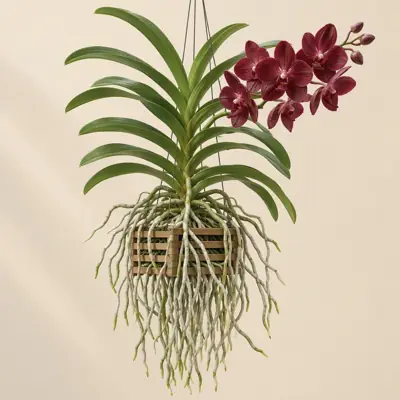
With few source data, mature height is reported to be about 20–60 cm. The leaves are reported to emerge continuously upward from a single stem and are commonly linear to strap-shaped, leathery, and folded, although leaf form can differ in some related groups or hybrid descendants. The flowers are reported to be showy and long-lasting, often large and flat with a smaller lip; cultivated plants may have purple, pink, yellow, white, or multicolored flowers, and some are fragrant. Flowering is reported to have no fixed season; native Vanda species can flower repeatedly at intervals, with individual flowers remaining in bloom for a period of time.
Light
Sources differ on light details: Vanda hybr needs high light with good airflow, while strap-leaved types may be grown in bright, diffused light and may benefit from some shading in hot conditions or during the hottest part of summer.
Watering
Vanda hybr generally suits a rapid wet-dry cycle: let it dry between waterings to an appropriate degree and then water thoroughly; greenhouse-grown, bare-root, or basket-grown plants generally need frequent watering, with more water potentially needed in hot summer conditions. Water should generally not remain for long periods on leaves or flowers or in poorly drained growing medium.
Humidity and airflow
Vanda hybr generally prefers high humidity and needs good airflow.
Temperature and dormancy
Vanda hybr is generally warm-growing and is reported to favor warm conditions. It is reported to be frost tender; keep above freezing.
Growing medium and mounting
Sources differ on growing systems: Vanda hybr may be grown bare-root, in baskets, or epiphytically without medium, while potted plants require a coarse medium that drains and dries rapidly, such as medium to coarse orchid bark; some systems also use sphagnum moss. It is generally epiphytic, may be mounted, and has aerial roots with velamen.
Feeding
Regular feeding is generally recommended during active growth, using a balanced formulation as an option, with feeding reduced or stopped when growth slows.
Propagation
Vanda hybr is reported to be difficult to propagate in home cultivation; when a side shoot occasionally forms, it may be separated after it has grown and developed roots.
Common problems
Thrips are reported to cause damage and may injure flower buds while they are still enclosed by bracts. Sources differ in their descriptions of fungal or bacterial diseases, including Fusarium wilt and rots associated with water remaining on leaves or flowers or with poor drainage; Fusarium infection may cause purple discoloration of vascular tissue, and contaminated cutting tools may spread the pathogen. Air that is too dry is reported to cause roots to dry out and leaves to drop, while disturbance or damage to the roots of mature plants may lead to an extended period without flowering and to weakening; prolonged water retention on leaves or flowers and poor drainage can also encourage rot. Vanda hybr is generally sensitive to cold but tolerant of heat; under high temperatures it needs correspondingly greater humidity, watering, airflow, and shading, and strong direct light during the hottest part of summer should also be moderated.
Identification
Vanda hybr is reported to be distinguished by an upright monopodial stem, rows of leathery strap-shaped leaves, numerous thick exposed aerial roots, and brightly colored, long-lasting flowers.