
vanilla (Vanilla planifolia)
Vanilla planifolia is an evergreen perennial climbing vine that grows along trees or other supports, produces aerial roots, and may grow epiphytically or semi-epiphytically.
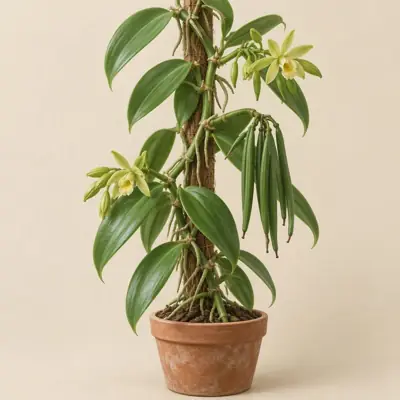
Overview
Vanilla planifolia is an evergreen perennial climbing vine that grows along trees or other supports, produces aerial roots, and may grow epiphytically or semi-epiphytically.
Origin and habitat
Sources differ on its native range: it is primarily described as native from Mexico to Central America, while some accounts also include Colombia, Brazil, or Bolivia. It inhabits warm, humid tropical lowland forest, where it commonly climbs trees and may grow epiphytically or root in the ground; sources differ in their accounts of its natural or wild elevation. Its climate is warm and humid tropical, with ample rainfall and a brief drier period.
Characteristics
Vines can reach 1000–1500 cm, and under suitable conditions they are reported to grow rapidly each month. The leaves are reported to be fleshy, flat, glossy, green to dark green, and lanceolate, oblong, or ovate-oblong, with pointed tips. Sources differ in their descriptions of the flowers: they are yellow-green to pale yellow, short-lived, and borne in inflorescences arising from the leaf axils, with some sources describing them as fragrant; in native lowland forest flowering occurs mainly near the end of the dry season, while other sources record flowering at different times under good cultivation. Sources differ in their descriptions of the elongated capsule fruits, which are produced by mature plants and, after processing, become the vanilla pods used as a spice.
Light
Vanilla planifolia does well in partial shade with medium light, in a bright, sheltered setting rather than full exposure; vines branch less in complete shade.
Watering
Water regularly during active growth and maintain moist conditions without prolonged excessive wetness, allowing the surface to become slightly dry before watering again; reduce watering during winter or a dry period used to encourage flowering. It is generally recommended to keep slightly dry.
Humidity and airflow
It generally prefers high humidity.
Temperature and dormancy
Vanilla planifolia is warm-growing, with an ideal temperature of 21–30 °C and a maximum of 33 °C. Sources differ on the lower temperature limit, placing it at about 10 °C. It is also reported to tolerate brief light frost. A single source reports a defined USDA hardiness range.
Growing medium and mounting
Vanilla planifolia is epiphytic and has aerial roots with velamen. When growing epiphytically, it can occupy places where humus accumulates on branches, and its growth is associated with mycorrhizal fungi; a French-language source specifically mentions symbiotic fungi of the genus Rhizoctonia.
Propagation
Vanilla planifolia can be propagated by cuttings, and sources also mention tissue-cultured plants; longer cuttings generally reach flowering or fruiting sooner than shorter ones.
Common problems
Prolonged complete shade can reduce branching, and without an appropriate dry period flowering may be difficult to induce. Flowers are short-lived, and plants grown where natural pollinators are absent generally require hand pollination or may have difficulty setting fruit. The plant prefers warm conditions and should be protected from strong winds; general accounts give a low-temperature tolerance threshold, while another horticultural source reports brief tolerance of light frost in mature plants and says young plants require protection from cold.
Identification
Vanilla planifolia is a large, fleshy climbing orchid with thick aerial roots emerging at stem nodes to attach to trees or other surfaces, and fleshy, flat leaves at the nodes; its pod-like fruits are an important commercial source of vanilla.
Photos


Sources
- GBIF Backbone: Vanilla planifolia Andrews — CC BY 4.0 · link
- Wikipedia (en): Vanilla planifolia — CC BY-SA 4.0 · link
- 維基百科:香莢蘭 — CC BY-SA 4.0 · link
- Wikipedia (ja): バニラ — CC BY-SA 4.0 · link
- Wikipedia (de): Gewürzvanille — CC BY-SA 4.0 · link
- Wikipedia (fr): Vanilla planifolia — CC BY-SA 4.0 · link
- Wikipedia (es): Vanilla planifolia — CC BY-SA 4.0 · link
- GBIF descriptions: The checklist of alien seed plants of D.R. Congo, based on evidence from herbarium collections; Catá — per dataset · link
- Useful Tropical/Temperate Plants: Vanilla planifolia — CC BY-NC-SA 3.0 (facts only) · link
- USDA PLANTS Database: Vanilla planifolia — Public domain (US Government work) · link
- Internet Orchid Species Photo Encyclopedia: Vanilla planifolia — © Jay Pfahl / IOSPE contributors, facts only · link
- Top Tropicals catalog: Vanilla planifolia — © Top Tropicals LLC (facts only) · link