
Japanese snowball (Viburnum plicatum)
Viburnum plicatum is a perennial, deciduous shrub with many branches and a spreading habit.
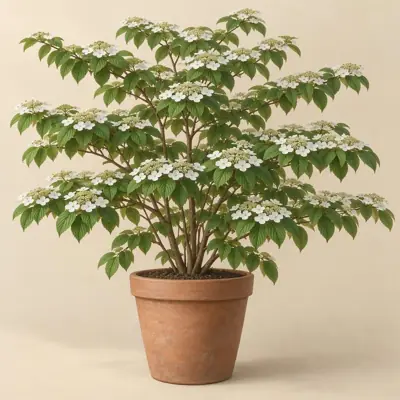
Overview
Viburnum plicatum is a perennial, deciduous shrub with many branches and a spreading habit.
Origin and habitat
Sources differ on its native range in East Asia, with accounts including China, Japan, Korea, and Taiwan. Sources differ on habitat descriptions, which include mountain scrub, mixed forests, and forest margins; Japanese var. tomentosum is also described from mountains, hills, and moister places near streams. It occurs in temperate to East Asian temperate environments and is strongly cold-hardy.
Characteristics
Sources differ on mature height, placing it at about 250–450 cm, while a single source reports a mature spread of about 250–400 cm. Growth is reported to be moderate, and sources describe opposite, simple, mainly ovate to elliptic leaves with conspicuously pleated venation and serrated margins. The inflorescences are usually flat, lacecap-like cymes or corymb-like clusters, with small yellowish-white fertile flowers in the center surrounded by larger, conspicuous white sterile flowers; some cultivars consist almost entirely of large sterile flowers and form snowball-like clusters, with flowering from spring to late spring. Sources differ in descriptions of the fruit, which is a drupe, ovate to elliptic, and may change from red to black or blue-black as it matures.
Light
It grows in full sun to partial shade.
Watering
Keep the soil moist but well drained, avoiding drought and waterlogging; mulch around the roots can help keep them cool and moist.
Temperature and dormancy
A single source reports cold tolerance to about -25 °C. It is generally rated RHS H6 for hardiness.
Growing medium and mounting
It is suited to moderately fertile, moist, well-drained chalk, clay, loam, or sand, tolerates acidic, neutral, or alkaline soil, and is less suited to poor or dry conditions.
Propagation
It can be propagated from seed, by semi-ripe cuttings in summer, or by grafting from late summer to winter; seed germination can be quite slow.
Common problems
Potential pests include aphids, viburnum beetles, and purple mites, although serious pest problems are not generally described. A single source reports susceptibility to blight, honey fungus-related disease, grey mould, and leaf spot. The root system is reported to be shallow, and damage to the roots from hoeing, drought, or waterlogging may cause some above-ground branches to die back or, in severe cases, the whole plant to die. It is generally reported to be strongly cold-hardy but unsuited to dry conditions, and may need some shade from morning sun in spring.
Identification
Distinguishing features include opposite, serrated, pleated leaves and lacecap-like inflorescences arranged along horizontal branches, usually with small fertile flowers surrounded by a ring of large white sterile flowers.
Photos


Sources
- Wikipedia (en): Viburnum plicatum — CC BY-SA 4.0 · link
- 維基百科:粉团 — CC BY-SA 4.0 · link
- Wikipedia (ja): ヤブデマリ — CC BY-SA 4.0 · link
- GBIF descriptions: Manual of the Alien Plants of Belgium; Global Register of Introduced and Invasive Species - Belgium — per dataset · link
- NC State Plant Toolbox: Viburnum plicatum — copyright (facts only) · link
- TaiCOL 臺灣物種名錄: Viburnum plicatum — CC BY 4.0 · link
- Useful Tropical/Temperate Plants: Viburnum plicatum — CC BY-NC-SA 3.0 (facts only) · link
- RHS Plants: Viburnum plicatum — © RHS, facts only · link
- USDA PLANTS Database: Viburnum plicatum — Public domain (US Government work) · link