
Hybrid violet (Viola × wittrockiana)
Viola wittrockiana is an herbaceous plant. Sources differ on its life cycle: it can be perennial in nature but is commonly cultivated horticulturally as an annual or biennial.
Overview
Viola wittrockiana is an herbaceous plant. Sources differ on its life cycle: it can be perennial in nature but is commonly cultivated horticulturally as an annual or biennial.
Origin and habitat
Accounts differ, but Viola wittrockiana is of horticultural hybrid origin, derived from several species in Viola section Melanium, especially V. tricolor, which is native to Europe and western Asia. A database reports environments including dry grassland, woodland edges and clearings, tall-herb communities, agricultural and horticultural cultivation areas, gardens and parks, and some built environments. It prefers mild to cool conditions and does not tolerate high temperatures; heat suppresses flowering, while hot, humid conditions may cause rot. It can withstand light frost and short periods of snow cover.
Characteristics
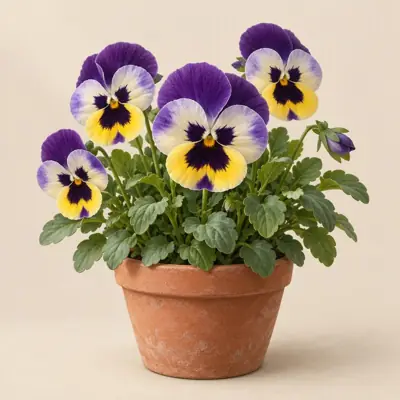
Its mature height is reported from a limited source to be about 0–23 cm. Sources differ in their descriptions of the flowers, which are large, conspicuous, and often multicolored, with upper, lateral, and lower petals; cultivated forms include yellow, golden yellow, orange, purple, violet, red, white, near-black, bicolored, and multicolored flowers, often with a prominent central marking. The leaves are reported to sometimes be heart-shaped. In Taiwan it is cultivated and flowers mainly from winter into spring, while in warm regions it can also flower in winter.
Light
It grows in full to partial sun, and good light supports continued flowering.
Watering
Watering should be adjusted for climate and rainfall, with thorough but gentle watering while avoiding overwatering; the growing medium should retain moisture while remaining aerated and well drained.
Temperature and dormancy
It is reported to overwinter in colder USDA hardiness zones, while in warmer USDA zones it can flower in winter and is commonly planted in autumn. It is generally frost hardy.
Growing medium and mounting
Use a well-drained, well-aerated growing medium; cultivation information also recommends clean peat soil or potting soil and avoiding excessive wetness that can lead to root rot.
Feeding
To promote flowering, plant fertilizer is reported to be applied regularly according to the type of fertilizer.
Propagation
It is reported to be propagated from seed, and an agricultural knowledge portal recommends sowing in autumn.
Common problems
Reported pests include aphids, slugs, and snails, and aphids can also transmit cucumber mosaic virus. Reported diseases include leaf spot caused by Ramularia deflectens, downy mildew caused by Peronospora violae, powdery mildew, stem rot, and cucumber mosaic virus infection. Overwatering or poor drainage and aeration can increase rot problems; high temperatures suppress flowering, while hot and humid conditions may cause rot and even plant death. It tolerates light frost and short periods of snow cover, but extreme cold or repeated freezing and thawing may require protective covering; it does not tolerate high temperatures or hot, humid conditions, and Taiwan sources also describe it as intolerant of rain exposure and unable to survive through summer.
Identification
Large, multicolored flowers are reported as a key horticultural feature; modern pansies often have a prominent dark central blotch, with petals oriented both upward and downward.
Sources
- GBIF Backbone: Viola × wittrockiana Gams — CC BY 4.0 · link
- Wikipedia (en): Pansy — CC BY-SA 4.0 · link
- Wikipedia (en): Viola wittrockiana — CC BY-SA 4.0 · link
- GBIF descriptions: Database of Vascular Plants of Canada (VASCAN); Checklist of introduced taxa in Romania; DAISIE - In — per dataset · link
- 農業知識入口網 植物圖鑑: Viola wittrockiana — © MOA, facts only · link
- NC State Plant Toolbox: Viola (genus-level) — copyright (facts only) · link