
oldfashioned weigela (Weigela florida)
Weigela florida is a deciduous shrub that typically becomes dense and spreading to rounded at maturity, with branches that may arch as they mature. It is reported to be perennial.
Overview
Weigela florida is a deciduous shrub that typically becomes dense and spreading to rounded at maturity, with branches that may arch as they mature. It is reported to be perennial.
Origin and habitat
The species is native to East Asia, principally parts of northern to central China, the Korean Peninsula, and Kyushu in Japan; sources differ on whether it is native to the Russian Far East. The species occurs in scrub and mixed woodland and is also widely cultivated in gardens, parks, hedges, and artificial landscapes. It is a temperate plant with cold tolerance and is suited to sunny to partly shaded conditions.
Characteristics
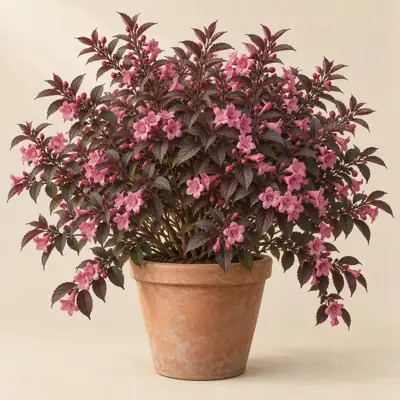
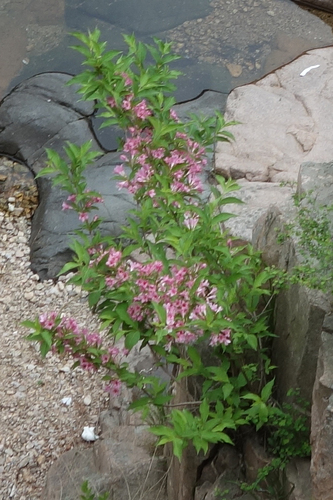
Sources differ on mature height, placing it at about 150–300 cm. Sources are few and differ on mature spread, placing it at about 150–250 cm; growth is generally described as moderate. The opposite, simple leaves are mainly ovate to elliptic with serrated or crenate margins; the species has hairy leaf surfaces, while 'Alexandra' (Wine & Roses) has glossy burgundy foliage. The funnel-shaped to tubular-bell-shaped flowers are usually pink to deep pink in the species and rose-red in 'Alexandra' (Wine & Roses), typically occurring on short lateral shoots or in the leaf axils; flowering is mainly from spring to early summer, with some plants flowering again more sparsely in summer and species records indicating that flowering can continue later.
Light
Weigela florida grows in full sun to partial sun, with full sun generally producing better flowering and foliage color.
Watering
It prefers moist but well-drained soil, and waterlogging around the roots should be avoided.
Temperature and dormancy
Sources differ on minimum temperature, with limited evidence placing it at about -20 °C. It is generally reported as having a USDA hardiness-zone range spanning several zones.
Growing medium and mounting
It prefers fertile, moist but well-drained soil and can adapt to loam, clay, sand, and calcareous soils under acidic, neutral, or alkaline conditions; Taiwanese agricultural information also recommends sandy loam containing organic matter.
Feeding
It is reported to benefit from regular seasonal feeding, with a source also recommending more frequent applications of liquid flowering fertilizer during pruning after summer flowering to promote blooming.
Propagation
Propagation can be by seed, cuttings, layering, or division, with cuttings commonly used horticulturally; softwood, semi-ripe, or mature woody cuttings can be used, with appropriate timing varying according to shoot maturity.
Common problems
Potential pests include foliar and bud nematodes, capsid bugs, and brown soft scale, and another source notes that deer may browse the plant. Sources differ on honey fungus: the RHS reports possible disease from it, while another database describes notable resistance to honey fungus in this genus. Pest and disease problems are generally reported to be minor, although winter shoot dieback can occur and plants left unpruned for long periods may become untidy. The plant has considerable cold tolerance but can still develop winter shoot dieback; it also has slight salt tolerance and can tolerate air pollution.
Identification
Wine & Roses is a trade name for the cultivar 'Alexandra', distinguished mainly by glossy burgundy foliage paired with rose-red flowers. The species can also be identified by opposite leaves, new shoots with two rows of hairs, and axillary tubular-bell-shaped flowers that appear after the leaves.
Photos


Sources
- Wikipedia (en): Weigela florida — CC BY-SA 4.0 · link
- Wikipedia (de): Liebliche Weigelie — CC BY-SA 4.0 · link
- GBIF descriptions: DAISIE - Inventory of alien invasive species in Europe — per dataset · link
- NC State Plant Toolbox: Weigela florida — copyright (facts only) · link
- 農業知識入口網 植物圖鑑: Weigela florida — © MOA, facts only · link
- Useful Tropical/Temperate Plants: Weigela florida — CC BY-NC-SA 3.0 (facts only) · link
- RHS Plants: Weigela florida — © RHS, facts only · link
- USDA PLANTS Database: Weigela florida — Public domain (US Government work) · link