
Foxtail palm (Wodyetia bifurcata)
Wodyetia bifurcata is an evergreen palm-like tree, mainly with a single trunk; sources describe its habit somewhat differently.
Overview
Wodyetia bifurcata is an evergreen palm-like tree, mainly with a single trunk; sources describe its habit somewhat differently.
Origin and habitat
Wodyetia bifurcata is native to a very restricted area around Cape Melville in northeastern Queensland, Australia, within Cape Melville National Park, and is now widely cultivated in tropical regions worldwide. It is reported to grow naturally on south-facing slopes among large granite boulders, in vine thickets and adjacent rainforest, on coarse sandy soil, from near sea level into higher terrain, and it can be dominant in local plant communities. Native to tropical northeastern Australia, it prefers warm, humid, sunny conditions in cultivation and is widely grown in tropical and subtropical landscapes.
Characteristics
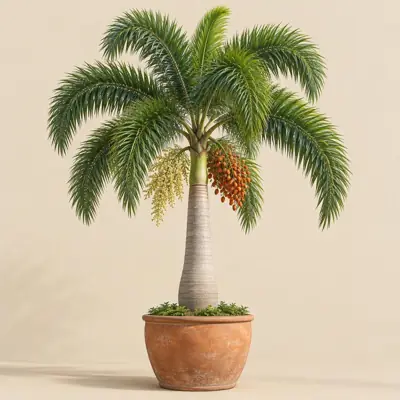
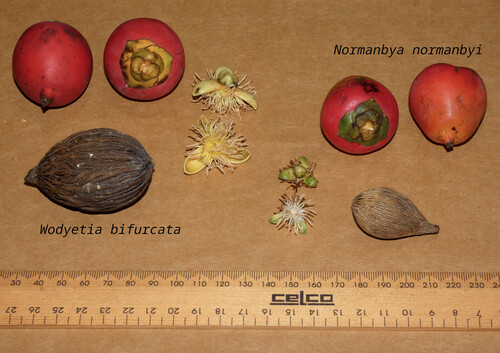
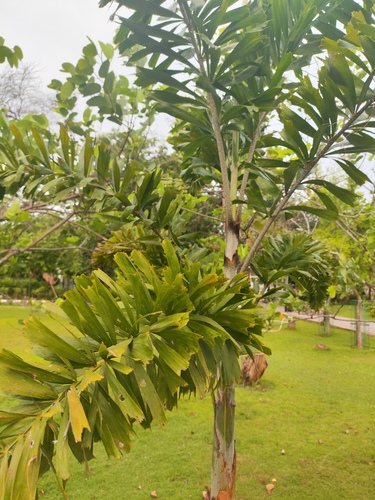
Mature height is reported at about 600–1500 cm, although sources differ. The large pinnate leaves are concentrated at the top of the stem, with lanceolate leaflets arranged radially or in whorls along the rachis and divided into many segments, creating a dense, fluffy, foxtail-like appearance. The plant is monoecious with separate male and female flowers; inflorescences arise near the base of the crownshaft, and flowers occur in groups containing female and male flowers, while sources differ in describing the flowers as yellow-green or white. The fruit is a drupe that becomes orange-red to reddish orange when mature and contains a large seed; sources differ in their descriptions of the fruit.
Light
Wodyetia bifurcata grows in full sun and requires bright light when grown indoors.
Watering
Water moderately after the surface soil has dried; sources also describe the plant as drought tolerant.
Temperature and dormancy
A lower temperature of about -1.1 °C is reported, though sources are few. A USDA hardiness classification is reported, though it comes from a single source. It is generally reported to tolerate brief light frost.
Growing medium and mounting
In its native habitat, Wodyetia bifurcata is reported from coarse sandy soils and slopes with granite boulders.
Propagation
Wodyetia bifurcata is reported to be propagated from seed.
Common problems
Mature plants can withstand brief light frost, while young plants require protection from cold; other sources describe the species as drought tolerant and wind resistant.
Identification
The most conspicuous feature is the dense, fluffy, foxtail-like crown formed by leaflets and segments arranged around the rachis; the trunk is smooth with prominent ring-shaped leaf scars, and mature fruit is orange-red.
Photos


Sources
- GBIF Backbone: Wodyetia bifurcata A.K.Irvine — CC BY 4.0 · link
- Wikipedia (en): Wodyetia — CC BY-SA 4.0 · link
- 維基百科:狐尾椰子 — CC BY-SA 4.0 · link
- Wikipedia (en): Wodyetia bifurcata — CC BY-SA 4.0 · link
- 臺北典藏植物園 植物資料庫: Wodyetia bifurcata — © 臺北典藏植物園, facts only · link
- Top Tropicals catalog: Wodyetia bifurcata — © Top Tropicals LLC (facts only) · link