
Arum Lilies (Zantedeschia hybrid)
Zantedeschia is reported to be an upright, clump-forming herbaceous plant with underground rhizomes or tubers. It is reported to be perennial, with species in the genus varying between deciduous and evergreen habits.
Overview
Zantedeschia is reported to be an upright, clump-forming herbaceous plant with underground rhizomes or tubers. It is reported to be perennial, with species in the genus varying between deciduous and evergreen habits.
Origin and habitat
Zantedeschia is native to Africa, principally central to southern Africa, but sources differ on the overall range, describing it either from the Nigeria and Tanzania region south to South Africa or from South Africa northeast to Malawi. Habitats vary within the genus; Z. aethiopica is reported to occur naturally in wet environments such as marshes and is also suited in cultivation to moist, humus-rich, or even muddy conditions. Cold tolerance is reported to vary markedly among species, while some species and hybrids grow best under moderately warm conditions.
Characteristics
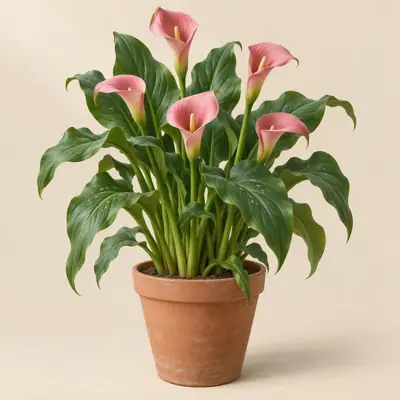
Sources differ on mature height, placing it at about 30.48–120 cm. Few sources report a mature spread of about 30.48–60.96 cm. The simple leaves are generally green and long-stalked, with shapes varying greatly by species, including arrow-shaped, heart-shaped, lance-shaped, ovate, elliptic, and oblong forms; some species have translucent or white spots. The spadix is reported to consist of many small unisexual flowers surrounded by a conspicuous spathe, commonly white or green but also yellow, orange, pink, red, or purple in some species and cultivars; sources differ on flowering season among species and cultivated forms.
Light
Zantedeschia is reported to grow from full sun to partial shade and tolerates some direct sun.
Watering
Zantedeschia is reported to prefer consistently moist conditions and can tolerate occasional standing water and muddy conditions; Z. aethiopica becomes deciduous when water is unavailable but can continue growing when water remains available.
Temperature and dormancy
Sources differ on hardiness across Zantedeschia, with some types described as more cold tolerant than others. Zantedeschia is generally described as frost hardy.
Growing medium and mounting
Zantedeschia is reported to prefer moist, humus-rich soil, with clay or loam acceptable and soil reactions ranging from acidic through neutral to alkaline. It is generally rhizomatous and suited to a moisture-retentive mix.
Feeding
Z. aethiopica is reported to continue growing when regularly supplied with water and fertilizer.
Propagation
Zantedeschia is reported to be propagated by division, by separating offsets, or by sowing harvested seed in autumn; Z. aethiopica can also be increased from lateral buds on the rhizome.
Common problems
In cold regions, outdoor plants are reported to risk failing to overwinter safely and may require thick mulch protection or lifting and storing their underground storage organs. Cold tolerance varies greatly within the genus, and some species, hybrids, and other types are reported to have suppressed growth under sustained high temperatures.
Identification
Zantedeschia is reported to have large, conspicuous spathes surrounding a central spadix, often arrow-shaped leaves that may bear translucent spots in some species, and underground storage organs that are fleshy rhizomes or tubers depending on the group.