
autumn zephyrlily (Zephyranthes candida)
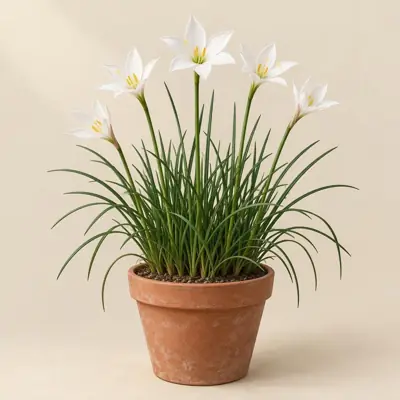
Zephyranthes candida is a clump-forming bulbous perennial herb with underground bulbs and basal linear leaves.
Overview
Zephyranthes candida is a clump-forming bulbous perennial herb with underground bulbs and basal linear leaves.
Origin and habitat
Zephyranthes candida is native to South America, with multiple sources supporting Argentina and Uruguay, while other accounts also list Brazil, Paraguay, Chile, or Peru; sources differ. It is reported from human-influenced places and roadsides and is reported to tolerate conditions ranging from relatively dry sites to wetlands.
Characteristics
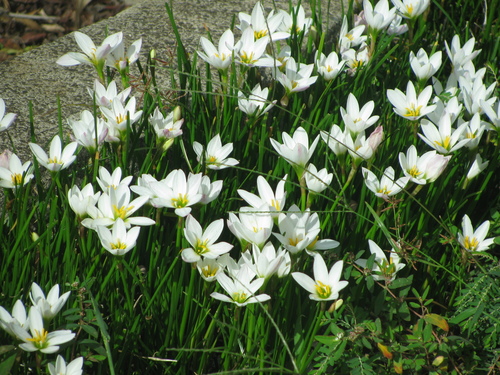
Sources differ on mature height, placing it at about 15–20 cm, while the few available sources report a mature spread of about 0–10 cm. It is reported to multiply well by producing and dividing bulbs; its basal leaves are linear to slender and rod-like and dark green. Flowers are solitary at the tips of flowering stems and white, sometimes pale reddish or pinkish outside, with a funnel-, cup-, or crocus-like perianth; flowering occurs from summer into early autumn, with Northern Hemisphere sources also reporting bud formation beginning in late August. The fruit is reported to be a nearly spherical capsule that splits into valves when mature, with black, flattened seeds.
Light
It grows in full sun to partial sun and generally performs better in full sun, although strong afternoon sun can be avoided in very hot areas.
Watering
Provide moderate moisture during growth; it tolerates wet soil, but in cultivation the soil should be kept moist and well drained. When kept indoors over winter in colder areas, it should be kept on the dry side, with potted plants watered only enough to prevent the growing medium from drying out completely.
Temperature and dormancy
A USDA hardiness zone range is reported for Zephyranthes candida.
Growing medium and mounting
It grows in moderately fertile, moist but well-drained soil and can be grown in chalky, loamy, or sandy soils with acidic, neutral, or alkaline conditions.
Propagation
It can be propagated by seed or by separating bulbs and offsets; offsets are suitable for separation in spring, and seeds can be sown when mature.
Common problems
Serious pest problems are generally absent, although slugs, snails, and mites may cause damage, and no conspicuous serious disease problems are generally reported. In very hot areas, strong afternoon sun may cause leaf decline and affect flowering, and excessive winter moisture should also be avoided. In colder climates, it is reported that bulbs should be lifted before the first frost and overwintered in a frost-free place, while strong afternoon light should be avoided in extremely hot conditions.
Identification
It is reported to have underground bulbs with a distinct neck and slender leaves resembling grass or onion leaves; each flowering stem usually bears a single white flower whose outer perianth may be faintly pink or pale red.
Photos



Sources
- Wikipedia (en): Zephyranthes candida — CC BY-SA 4.0 · link
- 維基百科:葱莲 — CC BY-SA 4.0 · link
- Wikipedia (ja): タマスダレ — CC BY-SA 4.0 · link
- Wikipedia (es): Zephyranthes candida — CC BY-SA 4.0 · link
- NC State Plant Toolbox: Zephyranthes candida — copyright (facts only) · link
- TaiCOL 臺灣物種名錄: Zephyranthes candida — CC BY 4.0 · link
- RHS Plants: Zephyranthes candida — © RHS, facts only · link
- USDA PLANTS Database: Zephyranthes candida — Public domain (US Government work) · link