
Pink Rain Lily (Zephyranthes carinata)
Zephyranthes carinata is a perennial herbaceous plant with an underground bulb.
Overview
Zephyranthes carinata is a perennial herbaceous plant with an underground bulb.
Origin and habitat
Sources differ on its native range, describing it as occurring in Mexico, Guatemala, and parts of Central America. It is reported to occur naturally mainly in moist, open places, including pastures, hillsides, and areas near woodland. It is reported to suit warm climates, to overwinter outdoors in warm areas, and to flower more readily after rain or under moist conditions.
Characteristics
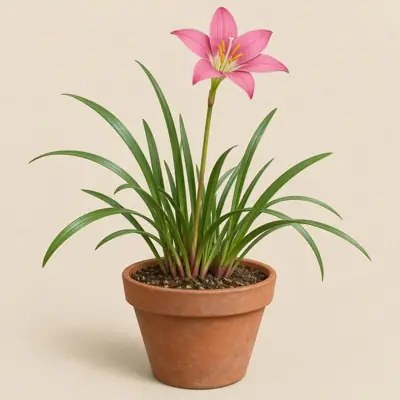
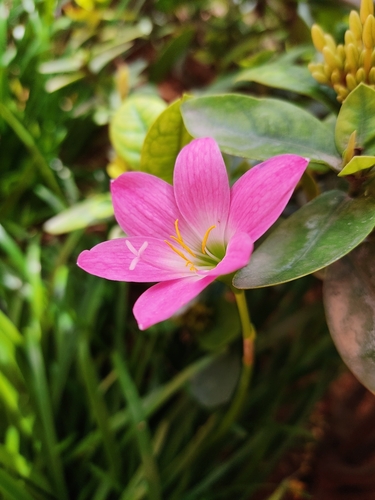
Its mature height is reported by few sources at about 20–30 cm. Sources differ in describing the leaves, which are linear, flat, relatively thick, and green with a slightly reddish base. Sources differ in describing the solitary, funnel-shaped flowers, which are mainly bright pink to rose-red and have a divided perianth. It is reported to flower after rainfall or a rainy period and, under moist climatic or cultivated conditions, may flower repeatedly or continuously through the year; the fruit is reported to be nearly spherical or lobed capsules with black, glossy, flattened seeds.
Light
It grows in full sun to partial sun; flowering is more abundant with ample sunlight, while excessive shade reduces flowering and the formation of daughter bulbs.
Watering
In cultivation, maintain suitable moisture while ensuring good drainage; flowering is often triggered by rainfall or increased moisture.
Temperature and dormancy
It is reported to tolerate brief light frost. A single source reports a hardiness-zone range, without a numerical range being stated here.
Growing medium and mounting
A loose, fertile, organic-rich, well-drained sandy loam is generally preferred.
Feeding
After severe pruning for renewal, slow-release fertilizer is reported to support renewed leaf growth.
Propagation
It is reported to be propagated by seed or division, with sowing suited to particular times of year under moist conditions and division generally possible throughout the year, with one period preferred. Overcrowded plants can also be divided and replanted.
Common problems
It is reported to form fewer daughter bulbs and flower more sparsely in overly dim conditions, while overcrowded clumps may require division. It is reported to be moderately cold-tolerant and able to overwinter outdoors in warm areas; an English-language source also describes it as more tolerant of low temperatures than some other Zephyranthes species.
Identification
Zephyranthes carinata has linear, chive-like leaves, an underground bulb, and large, solitary, pink, funnel-shaped flowers, and it often flowers in a flush after heavy rain.
Photos


Sources
- Wikipedia (en): Zephyranthes carinata — CC BY-SA 4.0 · link
- Wikipedia (ja): サフランモドキ — CC BY-SA 4.0 · link
- Wikipedia (es): Zephyranthes carinata — CC BY-SA 4.0 · link
- GBIF descriptions: Lista de especies de plantas exóticas y trasplantadas de Colombia; Catálogo de Plantas y Líquenes de — per dataset · link
- 農業知識入口網 植物圖鑑: Zephyranthes carinata — © MOA, facts only · link
- NC State Plant Toolbox: Zephyranthes (genus-level) — copyright (facts only) · link