
narrowleaf zinnia (Zinnia angustifolia)
Zinnia angustifolia is a clump-forming, highly branched herbaceous flowering plant. Sources differ in describing its life cycle as annual.
Overview
Zinnia angustifolia is a clump-forming, highly branched herbaceous flowering plant. Sources differ in describing its life cycle as annual.
Origin and habitat
Zinnia angustifolia is native to northern and western Mexico and is introduced or naturalized in parts of the continental United States. It is reported from grasslands or pastures on the highlands of northern and western Mexico.
Characteristics
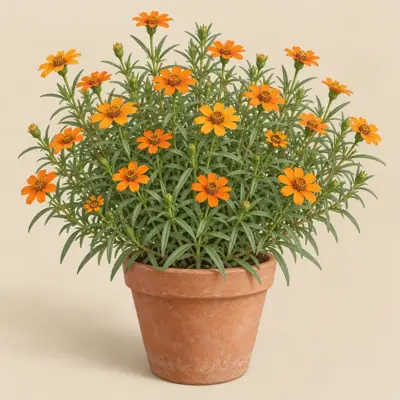
Sources differ on mature height, with a reported range of about 20.32–40.64 cm. The opposite, sessile leaves are narrowly linear to linear-lanceolate or narrowly elliptic and usually have a single prominent vein. The flower heads are small, usually with a single row of ray florets; wild forms have mainly bright orange to orange-yellow ray florets, which may also be yellow, while cultivated varieties include white and other flower colors. Sources differ on flowering period, describing flowering from summer until frost and, in another context, a more limited seasonal period; the fruit is reported to have an awn.
Light
It is reported to grow in full sun.
Watering
It is reported to be highly drought tolerant, suited to well-drained to slightly dry soil, and best kept from remaining overly wet for prolonged periods.
Growing medium and mounting
It is reported to suit well-drained to slightly dry clay or loam, with compost added before planting improving plant quality.
Common problems
A source reports no notable species-specific insect pests and notes that deer rarely cause damage. Possible diseases are reported to include southern bacterial wilt and southern blight of herbaceous ornamentals, while some cultivated varieties show good resistance to Phytophthora-related diseases. Overall, it is reported to have no significant problems, and some cultivated varieties have shown good Phytophthora resistance.
Identification
Zinnia angustifolia can be distinguished by its narrow, opposite, sessile leaves, usually with a single prominent vein, and by its relatively small flower heads with overlapping, blunt-tipped involucral bracts and usually a single row of ray florets.
Photos


Sources
- Wikipedia (en): Zinnia angustifolia — CC BY-SA 4.0 · link
- Wikipedia (de): Schmalblättrige Zinnie — CC BY-SA 4.0 · link
- NC State Plant Toolbox: Zinnia angustifolia — copyright (facts only) · link
- TaiCOL 臺灣物種名錄: Zinnia angustifolia — CC BY 4.0 · link
- USDA PLANTS Database: Zinnia angustifolia — Public domain (US Government work) · link