
Zygopetalum hybrid (Zygopetalum hybrid)
Zygopetalum is reported to be a perennial herbaceous orchid, with most members growing as epiphytes and some growing terrestrially.
Overview
Zygopetalum is reported to be a perennial herbaceous orchid, with most members growing as epiphytes and some growing terrestrially.
Origin and habitat
Zygopetalum is reported from South America, including Brazil, Peru, Paraguay, Bolivia, and northeastern Argentina, with most species occurring in Brazil. It is reported to inhabit humid forests at low to middle elevations, where it may grow epiphytically or terrestrially.
Characteristics
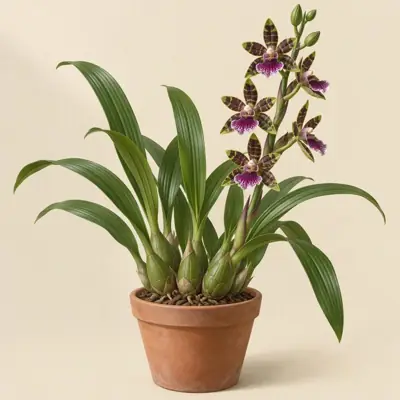
Sources differ on mature height, giving a range of about 30–61 cm. The leaves are reported to be glossy, strap-shaped to oblong or elliptic-lanceolate, sometimes pleated, and pointed to tapering at the tip. The long-lasting, fragrant flowers may have a waxy texture and occur in green, purple, burgundy, berry red, white, or multiple colors, often with contrasting stripes or spots; they are borne in racemes whose stalks are usually taller than the leaves. Sources differ on flowering season, which varies with growing location and source.
Light
Zygopetalum is generally suited to medium light or bright indirect light while avoiding excessively strong direct sun; in warm, humid conditions, increased shade and ventilation are recommended.
Watering
Keep the medium evenly moist without waterlogging, with more water during active growth and less during cooler periods; sources differ on whether the medium should remain from drying completely or be allowed to dry before watering again.
Humidity and airflow
Sources differ, but the reported humidity range is about 40–75 %, and Zygopetalum generally prefers moderate humidity. It generally needs good airflow.
Temperature and dormancy
Sources differ on the reported minimum temperature, while a maximum temperature is also reported by a specialist source.
Growing medium and mounting
A well-draining orchid medium that retains moisture is generally recommended, including bark-based media or moisture-retentive mixtures of coconut husk and perlite. Zygopetalum is reported to be epiphytic.
Feeding
Regular dilute feeding during the growing period is generally recommended, with sources differing in fertilizer formulation, concentration, and timing.
Propagation
Zygopetalum is reported to be commonly propagated by division, keeping several pseudobulbs in each division and avoiding divisions that are too small.
Common problems
Reported pests include slugs, aphids, spider mites, mealybugs, and scale insects; slugs may hide beneath pots and feed on emerging flower buds. Overwatering is reported to cause root rot, while black leaf spots may occur and are associated with a combination of poor airflow, wet leaves, and low temperatures. Older leaves are reported to develop black spots that are generally associated with growing conditions and are not observed to spread conspicuously to other plants or reduce vigor; insufficient light may also result in poor flowering. Zygopetalum is generally described as having low cold tolerance and moderate heat tolerance; hot, humid conditions call for more shade, airflow, and suitable watering to help cool the leaves.
Identification
Zygopetalum is reported to have ovate to conical pseudobulbs and fragrant, boldly patterned flowers, with a purple lip often emphasized as a decorative feature.