
Zygopetalum maculatum (Zygopetalum maculatum)
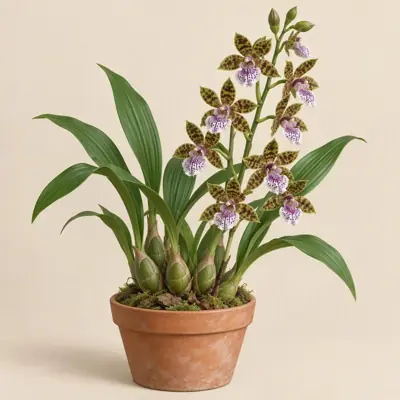
Zygopetalum maculatum is reported to be an epiphytic orchid with smooth, ovoid pseudobulbs. It is reported to be a perennial evergreen orchid.
Overview
Zygopetalum maculatum is reported to be an epiphytic orchid with smooth, ovoid pseudobulbs. It is reported to be a perennial evergreen orchid.
Origin and habitat
Zygopetalum maculatum is native to Peru, Bolivia, and Brazil. Sources differ in describing its habitat, including flat, very wet, moss-covered, semi-marshy environments at middle to high elevations. It is reported to occur naturally in very wet, middle- to high-elevation environments that are cool to cold.
Characteristics
Sources differ, but the mature height is reported at about 30–40 cm. Each pseudobulb typically bears lance-shaped, slightly thick, pleated leaves with pointed to tapering tips. Sources differ in their measurements of the inflorescences and flowers; the fragrant flowers have green floral segments marked reddish-brown to purplish-brown and a white lip with purple markings. Sources differ, but flowering is described as occurring mainly in spring.
Light
Sources differ: cultivation information generally recommends bright light or bright indirect light with more shade in hot, humid conditions, while specialist information for this species describes deep shade.
Watering
It is generally recommended to keep evenly moist, with the growing medium uniformly and slightly moist but not waterlogged; water needs are greater during active growth and watering can be reduced in cooler periods.
Humidity and airflow
Sources differ, but reported humidity is about 40–75 %. It is generally described as preferring moderate humidity and needing good airflow.
Temperature and dormancy
Zygopetalum maculatum is generally described as cool-growing.
Growing medium and mounting
It is generally grown as an epiphytic orchid in a moisture-retentive but well-drained orchid medium, such as a bark-based mix or coconut husk with perlite. Bark is reported as a preferred growing medium.
Feeding
Sources differ, but diluted fertilizer is recommended regularly during active growth, with the fertilizer selected according to water quality.
Propagation
It is reported to be propagated by division, with multiple pseudobulbs retained in each division.
Common problems
Aphids, spider mites, mealybugs, scale insects, and slugs are reported as possible pests, and slugs may feed on emerging flower buds. Sources differ, but excessive watering is associated with root rot, while poor airflow combined with wet leaves and low temperatures may be associated with black leaf spots. Black spots are reported on older leaves, and AOS reports that these appear related to growing conditions without evidence of spread to other plants or reduced plant vigor. It prefers cool conditions; in hot, humid conditions, increased shade, airflow, and appropriate watering are recommended to help cool the leaves.
Identification
Zygopetalum maculatum has pseudobulbs and pleated leaves, with upright to arching racemes bearing large, fragrant flowers with green floral segments marked brown and a white lip with prominent purple markings.
Photos


Sources
- Wikipedia (en): Zygopetalum maculatum — CC BY-SA 4.0 · link
- Internet Orchid Species Photo Encyclopedia: Zygopetalum maculatum — © Jay Pfahl / IOSPE contributors, facts only · link
- AOS culture sheet: Zygopetalum (genus-level) — © American Orchid Society, facts only · link
- NHK みんなの趣味の園芸 植物図鑑: Zygopetalum (genus-level) — © NHK出版, facts only · link
- NC State Plant Toolbox: Zygopetalum (genus-level) — copyright (facts only) · link