
wild chives (Allium schoenoprasum)
Allium schoenoprasum is a perennial, clump-forming herb with bulbs.
Overview
Allium schoenoprasum is a perennial, clump-forming herb with bulbs.
Origin and habitat
Sources differ on its native range, but describe it as mainly native to temperate parts of the Northern Hemisphere, including Europe, Asia, and North America. It occurs in rocky grasslands and moist meadows, prefers calcareous soils, and is also widespread in cultivated settings. It is adapted to temperate Northern Hemisphere climates and can also be cultivated at middle elevations in subtropical and tropical regions.
Characteristics
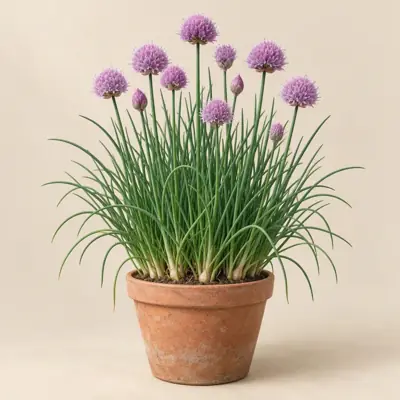
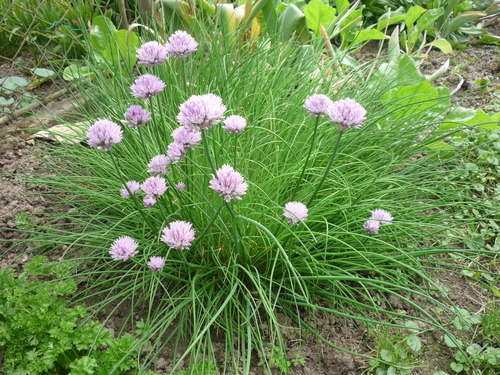
Sources differ on mature height, placing it at about 5–50 cm, while the few available sources report a mature spread of about 0–10 cm. The leaves are narrow, cylindrical, hollow, grass-like, green to gray-green, shorter than the flowering stems, and have an onion- or garlic-like aroma. The dense, nearly spherical flower clusters are mainly pale purple, purplish red, or pink, and the flowers attract pollinating insects. Sources differ on flowering timing, describing flowering from spring into summer; the fruit is reported to be a small capsule that can mature in summer, with fruiting less frequent under some cultivated or regional conditions.
Light
It grows in full sun to partial sun, with full sun described as preferable.
Watering
The soil should be kept moist but well drained, though the plant can also grow in ordinary well-drained soil.
Temperature and dormancy
A limited source reports an ideal temperature range of about 10–20 °C.
Growing medium and mounting
It prefers well-drained soil rich in organic matter and can adapt to chalk, clay, loam, and sand, as well as acidic, neutral, or alkaline conditions.
Feeding
A limited source reports that a small amount of supplemental fertilizer can be applied after establishment.
Propagation
It can be propagated by seed or division, and mature clumps can be divided in spring or autumn.
Common problems
It is reported to be susceptible to bulb mites and other pests associated with onions.
Identification
Key features are slender, hollow, tubular leaves that are nearly circular in cross-section and dense clumps formed from small bulbs. Its cylindrical, hollow leaves distinguish it from Allium tuberosum, which has flat, strap-like leaves.
Photos


Sources
- Wikipedia (en): Chives — CC BY-SA 4.0 · link
- 維基百科:蝦夷蔥 — CC BY-SA 4.0 · link
- Wikipedia (ja): チャイブ — CC BY-SA 4.0 · link
- Wikipedia (de): Schnittlauch — CC BY-SA 4.0 · link
- Wikipedia (fr): Ciboulette commune — CC BY-SA 4.0 · link
- GBIF descriptions: Manual of the Alien Plants of Belgium; Database of Vascular Plants of Canada (VASCAN); Nordic crop w — per dataset · link
- NC State Plant Toolbox: Allium schoenoprasum — copyright (facts only) · link
- Useful Tropical/Temperate Plants: Allium schoenoprasum — CC BY-NC-SA 3.0 (facts only) · link
- RHS Plants: Allium schoenoprasum — © RHS, facts only · link
- USDA PLANTS Database: Allium schoenoprasum — Public domain (US Government work) · link