
pineapple (Ananas comosus)
Ananas comosus is a terrestrial, clumping, evergreen perennial herb with leaves arranged in a rosette.
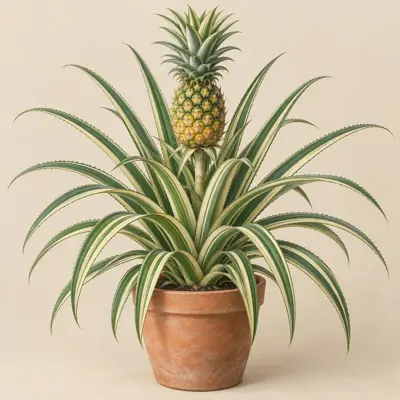
Overview
Ananas comosus is a terrestrial, clumping, evergreen perennial herb with leaves arranged in a rosette.
Origin and habitat
It is native to South America, with more specific accounts pointing to an area from southern Brazil toward Paraguay and also to southeastern Brazil. It is terrestrial and is recorded from savanna; in cultivation it is adapted to tropical lowlands and well-drained acidic soil. It occurs in tropical to some subtropical conditions, is adapted to warmth, and has drought tolerance.
Characteristics
Sources differ on mature size, describing a height of about 50–150 cm and, from few sources, a spread of about 100–150 cm. Growth is slow, and the stiff, narrow to lance-shaped or strap-like leaves form a dense rosette; some forms have spiny leaf margins. Sources differ in their descriptions of the densely clustered terminal inflorescence, with flowers described mainly as purple or as white with pale purple, and flowering is reported in summer. Sources differ in describing the mature multiple fruit as fleshy and red, yellow, or orange, with a crown of leaves at the top.
Light
It prefers full sun to bright light; indoors it can receive bright indirect light, while insufficient light may lead to weaker growth and smaller fruit. Bright conditions with direct morning sun are suitable.
Watering
Provide water during active growth while keeping the medium well drained; the potting medium can be allowed to dry before watering again, and prolonged excessive wetness should be avoided. Water needs are greater during fruiting and should be reduced outside periods of active growth. Water the pot; staying moist is fine.
Humidity and airflow
It prefers high humidity. It is generally reported to need little air movement and to have a low airflow need.
Temperature and dormancy
The ideal temperature is 21–30 °C. Sources differ on a lower temperature figure of about 10 °C, while the stated cold minimum is 10 °C. Few sources report an upper temperature figure of about 36 °C. It is generally reported to tolerate brief light frost.
Growing medium and mounting
Use a well-drained, acidic medium; sandy or organic-rich soil can be used, and sources also describe loam and a potting mixture of Kanuma soil with leaf mold. It is grown potted.
Feeding
Feed during the growing period from spring through autumn with either a balanced nitrogen, phosphorus, and potassium fertilizer or one somewhat higher in phosphorus; during fruiting, RHS recommends regular balanced liquid fertilizer.
Propagation
Vegetative propagation can use the crown from the top of the fruit, basal suckers, or plantlets formed near the inflorescence. After removing a crown, its cut surface can be allowed to dry or heal before planting it in a well-drained medium.
Common problems
Scale insects may occur, with mealybugs and spider mites also recorded. Few diseases are recorded overall, but prolonged excessive wetness can lead to root rot. Insufficient sun may result in weaker growth and smaller fruit, while dry indoor conditions may make scale insects more likely. It does not tolerate frost or prolonged cold, which can cause serious injury or death under sufficiently cold conditions.
Identification
For 'Variegatus', variegated foliage is a key identifying feature; the plant also has the characteristic stiff rosette of leaves, a central inflorescence, and a multiple fruit topped by a leafy crown, and it is also grown as an ornamental potted plant.
Photos


Sources
- GBIF Backbone: Ananas comosus (L.) Merr. — CC BY 4.0 · link
- Wikipedia (en): Pineapple — CC BY-SA 4.0 · link
- 維基百科:凤梨 — CC BY-SA 4.0 · link
- Wikipedia (ja): パイナップル — CC BY-SA 4.0 · link
- Wikipedia (de): Ananas — CC BY-SA 4.0 · link
- Wikipedia (fr): Ananas — CC BY-SA 4.0 · link
- Wikipedia (es): Ananas comosus — CC BY-SA 4.0 · link
- NC State Plant Toolbox: Ananas comosus — copyright (facts only) · link
- Useful Tropical/Temperate Plants: Ananas comosus — CC BY-NC-SA 3.0 (facts only) · link
- RHS Plants: Ananas comosus — © RHS, facts only · link
- USDA PLANTS Database: Ananas comosus — Public domain (US Government work) · link
- NHK みんなの趣味の園芸 植物図鑑: Ananas comosus — © NHK出版, facts only · link
- Top Tropicals catalog: Ananas comosus — © Top Tropicals LLC (facts only) · link