
field mustard (Brassica rapa)
Brassica rapa is an upright herb that may grow in a clustered to columnar upright form. It may be annual or biennial.
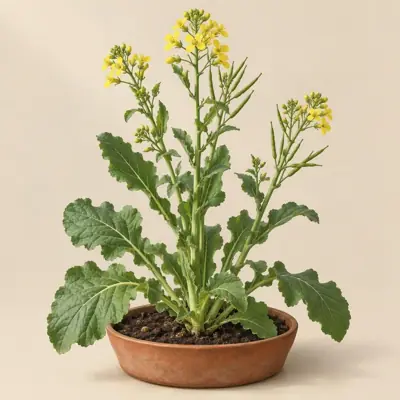
Overview
Brassica rapa is an upright herb that may grow in a clustered to columnar upright form. It may be annual or biennial.
Origin and habitat
Sources differ on its native range: broad accounts point to Eurasia, with differing ranges including Europe, Central Asia, the Caucasus, Western Asia, the Arabian Peninsula, North Africa, and northeastern tropical Africa, while recent genetic research places genuinely wild populations more toward the Caucasus and Central Asia. It occurs in cultivated fields, vegetable gardens, and other environments influenced by human activity; historical accounts also describe it as a weed of farmland from Western Asia to northern Europe. It is reported to prefer cool, moist growing conditions and is a temperate crop; it can also be cultivated at higher elevations in tropical and subtropical regions and can tolerate frost and light freezing.
Characteristics
Sources are few and differ on mature height, placing it at about 100–150 cm; a single source reports a mature spread of about 50–100 cm. It grows rapidly. The leaves are green; lower leaves are larger and stalked, with margins that may be wavy or toothed and sometimes divided, while upper leaves are smaller, stalkless, and narrower, with bases that may be heart-shaped, eared, and clasping the stem. The flowers are reported to be yellow and cross-shaped and may be followed by slender pods; the slender green pods have elongated pointed tips and contain dark brown to black seeds, while USDA also records the seed or fruit color as brown.
Light
Brassica rapa grows in full sun.
Watering
It prefers moist but well-drained conditions, and the soil should not be allowed to dry out while seedlings are growing rapidly.
Temperature and dormancy
Sources are few; a single source reports about 7 °C as the minimum temperature, about 10–17 °C as the ideal range, and about 30 °C as the maximum.
Growing medium and mounting
It grows in fertile, well-drained soil and can adapt to sandy, loamy, clay, and chalky soils, while preferring deep, loose, highly fertile soil. Sources differ on soil reaction: The Ferns describes a preferred and tolerated pH span, while RHS recommends neutral to alkaline soil that is not overly acidic.
Feeding
Brassica rapa has high soil-fertility requirements.
Common problems
It is reported to attract butterflies and pollen beetles. It tolerates frost and light freezing, but tender growth can suffer severe frost damage under sufficiently cold conditions; it has low drought tolerance and prefers cool, moist conditions.
Identification
Brassica rapa is highly variable in form; typical plants have larger stalked lower leaves, smaller stalkless upper leaves, yellow cross-shaped flowers, and slender pointed pods. Cultivated forms include types characterized by enlarged roots, leafy vegetables, or oilseed production.
Photos


Sources
- Wikipedia (en): Brassica rapa — CC BY-SA 4.0 · link
- 維基百科:芸薹 — CC BY-SA 4.0 · link
- Wikipedia (ja): ブラッシカ・ラパ — CC BY-SA 4.0 · link
- Wikipedia (de): Rübsen (Pflanze) — CC BY-SA 4.0 · link
- GBIF descriptions: Manual of the Alien Plants of Belgium; The checklist of alien seed plants of D.R. Congo, based on ev — per dataset · link
- Useful Tropical/Temperate Plants: Brassica rapa — CC BY-NC-SA 3.0 (facts only) · link
- RHS Plants: Brassica rapa — © RHS, facts only · link
- USDA PLANTS Database: Brassica rapa — Public domain (US Government work) · link