
Thai Bai Makrut (Citrus hystrix)
Citrus hystrix is an evergreen, thorny shrub or small tree that may have a clustered habit. It is reported to be perennial.
Overview
Citrus hystrix is an evergreen, thorny shrub or small tree that may have a clustered habit. It is reported to be perennial.
Origin and habitat
Sources differ in describing its native range as tropical Southeast Asia. It is reported that its habitat in a truly wild state is currently unclear and that it occurs widely as a cultivated plant. It is suited to tropical to subtropical citrus-growing climates and can also be grown in greenhouses, warm glasshouses, or containers.
Characteristics
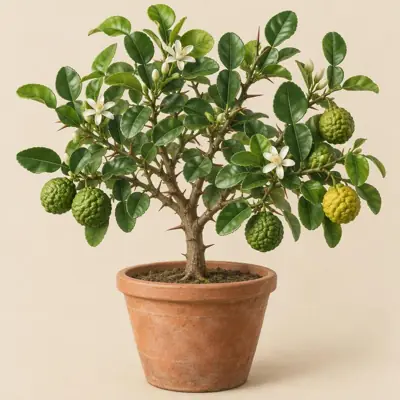
Sources differ, with few sources indicating a mature height of about 250–400 cm; a single source reports a mature spread of about 100–150 cm. The evergreen leaves are glossy dark green and strongly aromatic, with conspicuously winged, flattened petioles resembling a second leaf and giving the whole leaf a distinctive double-leaf or hourglass-like appearance. The flowers are white to off-white and fragrant, and flowering is reported to be possible throughout the year. Sources differ in describing the citrus fruit, which has a conspicuously rough, bumpy rind that usually changes from green toward yellow or yellow-green, with a strongly sour character and relatively little juice.
Light
Grow in full sun or a very bright position; full light is recommended, though some shade can be provided under hot, intense light.
Watering
Keep the growing medium moist but well drained, water thoroughly during spring and summer growth, reduce watering in winter, and generally allow the surface to dry slightly before watering again.
Temperature and dormancy
With few sources available, a minimum of about 13 °C, an ideal range of about 25–30 °C, and a maximum of about 38 °C are reported. Sources differ in their descriptions of hardiness. It is generally reported to tolerate brief light frost.
Growing medium and mounting
It prefers deep, well-drained loam that retains moisture; for containers, a peat-free loam-based medium with coarse material added to improve drainage can be used. Sources describe the preferred soil reaction as acidic to neutral.
Feeding
It is generally recommended to use a citrus fertilizer according to the product label and to feed throughout the year.
Propagation
It is reported to germinate from seed.
Common problems
It is sensitive to freezing and frost; in cool regions, containers can be moved into a greenhouse or frost-free setting during winter, while occasional brief light frost may be tolerated but prolonged cold should be avoided. Growth is reported to stop under temperatures that are too low or too high, and prolonged drought requires additional water.
Identification
The most conspicuous identifying features are thorny branches, aromatic double-leaf-like leaves formed by winged petioles, and small green citrus fruits with strongly bumpy surfaces.
Photos


Sources
- Wikipedia (en): Kaffir lime — CC BY-SA 4.0 · link
- 維基百科:馬蜂橙 — CC BY-SA 4.0 · link
- Wikipedia (ja): コブミカン — CC BY-SA 4.0 · link
- Wikipedia (de): Kaffernlimette — CC BY-SA 4.0 · link
- Wikipedia (fr): Combava — CC BY-SA 4.0 · link
- Wikipedia (es): Citrus hystrix — CC BY-SA 4.0 · link
- Wikipedia (it): Citrus hystrix — CC BY-SA 4.0 · link
- Wikipedia (nl): Mauritius papeda — CC BY-SA 4.0 · link
- Useful Tropical/Temperate Plants: Citrus hystrix — CC BY-NC-SA 3.0 (facts only) · link
- RHS Plants: Citrus hystrix — © RHS, facts only · link
- USDA PLANTS Database: Citrus hystrix — Public domain (US Government work) · link
- Top Tropicals catalog: Citrus hystrix — © Top Tropicals LLC (facts only) · link