
jade plant (Crassula ovata)
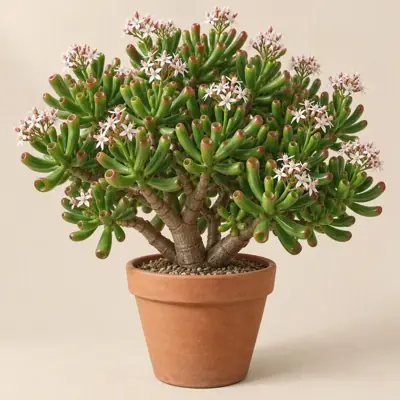
Crassula ovata is an evergreen, succulent, perennial shrub or subshrub with an upright to spreading, freely branching habit.
Overview
Crassula ovata is an evergreen, succulent, perennial shrub or subshrub with an upright to spreading, freely branching habit.
Origin and habitat
Sources differ on its native range, describing southern Africa with a core distribution in South Africa's Eastern Cape and KwaZulu-Natal and an extension into Mozambique. It grows on rocky slopes, hills and fields, as well as among shrubs in open woodland and in sheltered ravines; one source describes the soil as sandy clay. It is adapted to warmer conditions in southern Africa and, in cultivation, favors ample sunlight, airflow and drier conditions while not tolerating hot, humid conditions or severe frost.
Characteristics
Sources differ on mature height, which is about 150–300 cm, while the few available sources report a mature spread of about 100–150 cm and generally describe growth as slow. The opposite, thick, succulent leaves are green to jade green and glossy; the typical form has obovate to elliptic or spoon-shaped leaves whose margins are often reddish, while 'Gollum' has tubular, trumpet-shaped leaves resulting from abnormal development of the growing point. Mature plants can produce clusters of small, star-shaped, white to pale pink flowers; sources differ on flowering season, generally placing it in cooler periods from late autumn into winter, with flowering extending into spring or occurring in late summer under some regional or cultivation conditions. The fruit is reported to be a follicle containing many tiny seeds, and the plant stores water in several organs.
Light
Sources differ on light conditions, describing bright light to full sun and recommending ample sunlight indoors; when moving a plant from a dark location into strong light, light exposure should be increased gradually to avoid leaf damage. Crassula ovata takes full sun.
Watering
Crassula ovata is drought tolerant; in a container with drainage holes, it can be watered thoroughly until water drains out, then left until the growing medium is completely dry before watering again, with watering substantially reduced in winter to avoid prolonged wetness that can cause leaf drop and root rot.
Humidity and airflow
It is generally reported to prefer low humidity and needs good airflow.
Temperature and dormancy
The few available sources report an ideal temperature of about 15–24 °C and a minimum of about 0 °C. It is generally reported to be frost tender and should be kept above freezing, and it rests in winter. A limited source describes its hardiness, while a source for 'Gollum' separately describes warm-region outdoor cultivation; the few available sources also place the cold minimum at about 0 °C. It performs poorly in hot, humid conditions and may shed leaves when weather is excessively hot or dry to reduce water loss.
Growing medium and mounting
Use a well-drained growing medium, such as cactus or succulent potting mix amended with mineral particles such as coarse sand, pumice or perlite, and use a container with drainage holes. Crassula ovata is prone to rot and needs a fast-draining mix.
Feeding
A small amount of slow-release chemical fertilizer or liquid fertilizer can be applied in spring; another cultivation recommendation calls for general liquid fertilizer monthly during growth in spring and summer.
Propagation
Crassula ovata can be propagated from leaf and stem cuttings, and the typical form is also recorded as being propagated by seed, division or offsets. Recorded propagation methods also include root cuttings.
Common problems
Potential pests include scale insects, mealybugs, aphids, spider mites and weevils. Excess moisture can cause root rot; sources differ in also listing rust, scab and soft rot in general cultivation information for the genus Crassula. It is generally reported that overwatering may cause leaf drop and rot, extreme water shortage may also cause damage, and abrupt movement from a dark location into strong light may damage leaves, while excessively strong sunlight may cause scorching or leaf drop. It does not tolerate hard frost or freezing and is unsuitable for prolonged hot, humid conditions; it should be moved indoors when freezing is a risk.
Identification
Its most distinctive feature is the tubular, fleshy leaf with a depressed, suction-cup-like tip; the tips can become reddish in strong light, distinguishing this horticultural form from the typical elliptic-leaved Crassula ovata.
Photos


Sources
- Wikipedia (en): Crassula ovata — CC BY-SA 4.0 · link
- 維基百科:翡翠木 — CC BY-SA 4.0 · link
- Wikipedia (ja): カネノナルキ — CC BY-SA 4.0 · link
- Wikipedia (de): Geldbaum — CC BY-SA 4.0 · link
- Wikipedia (fr): Crassula ovata — CC BY-SA 4.0 · link
- Wikipedia (es): Crassula ovata — CC BY-SA 4.0 · link
- GBIF descriptions: DAISIE - Inventory of alien invasive species in Europe — per dataset · link
- NC State Plant Toolbox: Crassula ovata — copyright (facts only) · link
- LLIFLE Encyclopedia of living forms: Crassula ovata — CC BY-SA · link
- RHS Plants: Crassula ovata — © RHS, facts only · link
- USDA PLANTS Database: Crassula ovata — Public domain (US Government work) · link
- The Succulent Plant Page: Crassula (genus-level) — © R.J. Hodgkiss, facts only · link
- NHK みんなの趣味の園芸 植物図鑑: Crassula ovata — © NHK出版, facts only · link
- Top Tropicals catalog: Crassula ovata — © Top Tropicals LLC (facts only) · link