
Italian Crocus (Crocus sativus)
Crocus sativus is a perennial terrestrial herb with an underground corm.
Overview
Crocus sativus is a perennial terrestrial herb with an underground corm.
Origin and habitat
Sources differ on its origins: its cultivated origin is closely associated with the eastern Mediterranean through Greece, and it may have arisen through human selection from the Greek wild species Crocus cartwrightianus; no true wild population of Crocus sativus is currently confirmed. Sources differ on its true wild habitat; it exists mainly as a crop with a long history of human cultivation. It is reported to be cultivable in temperate regions and regions with hot, dry summers; it is also reported to tolerate cold, while flowering may require prior hot, dry summer conditions.
Characteristics
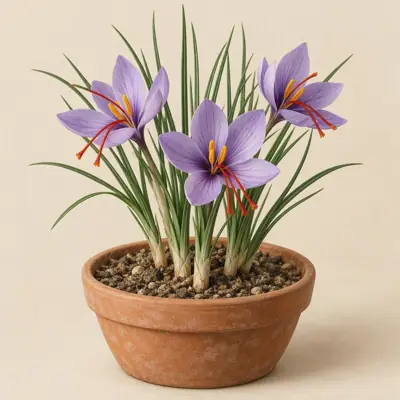
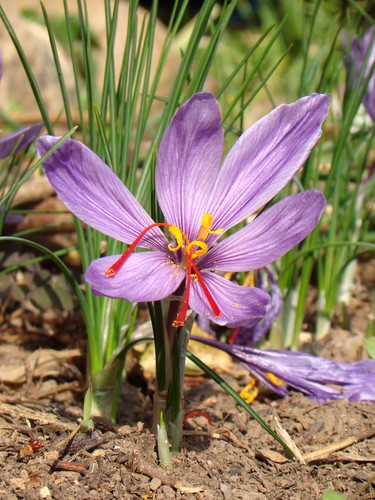
Sources differ on mature height, placing it at about 10–30 cm, while the few available sources report a mature spread of about 0–10 cm. The simple leaves are narrow to linear and grass-like, forming rosettes or clumps with entire margins; they generally appear around the autumn flowering period and continue growing until dormancy in late spring. It flowers in autumn, with purple to pale-purple flowers and prominent red to orange-red stigmas. Sources differ regarding its reproductive condition, but it is described as sexually sterile and generally unable to produce seed through normal sexual reproduction.
Light
Crocus sativus grows in full sun.
Watering
It requires well-drained conditions and should not remain persistently wet or waterlogged; once established, it can adapt to alternating dry and wet conditions.
Temperature and dormancy
It is generally reported to be frost hardy. A single source places it within a defined USDA hardiness-zone range.
Growing medium and mounting
It is suited to well-drained sandy or loamy soil and can also grow in calcareous soil; suitable soils include chalk, loam, and sand, with neutral to alkaline pH preferred.
Feeding
It is generally reported not to favor excessively fertile conditions, and fertile soil may reduce the yield of saffron spice.
Propagation
It is propagated vegetatively by separating or dividing corms and replanting them; sexual sterility associated with triploidy means normal seed propagation cannot be relied upon.
Common problems
Squirrels, mice, and other rodents are reported to feed on the corms. Fungal disease is reported to occur during wet flowering conditions, while excessively wet soil may cause root rot. Poor drainage and excessive moisture are major cultivation risks, and unsuitable summer conditions may allow growth while preventing normal flowering. Wet weather during flowering increases the risk of fungal disease, while hot, dry summer conditions are associated with subsequent flowering.
Identification
Crocus sativus is a triploid corm plant with purple autumn flowers and long, conspicuous red to orange-red stigmas; the dried stigmas are the spice saffron. It can be distinguished from the similar-looking Colchicum by features including the number of stamens.
Photos


Sources
- Wikipedia (en): Crocus sativus — CC BY-SA 4.0 · link
- 維基百科:番紅花 — CC BY-SA 4.0 · link
- Wikipedia (ja): サフラン — CC BY-SA 4.0 · link
- Wikipedia (de): Safran — CC BY-SA 4.0 · link
- Wikipedia (fr): Crocus sativus — CC BY-SA 4.0 · link
- Wikipedia (es): Crocus sativus — CC BY-SA 4.0 · link
- NC State Plant Toolbox: Crocus sativus — copyright (facts only) · link
- Wikipedia (pt): Crocus sativus — CC BY-SA 4.0 · link
- Useful Tropical/Temperate Plants: Crocus sativus — CC BY-NC-SA 3.0 (facts only) · link
- RHS Plants: Crocus sativus — © RHS, facts only · link
- Top Tropicals catalog: Crocus sativus — © Top Tropicals LLC (facts only) · link